
What Made Dalí's Love Story So Lethal?
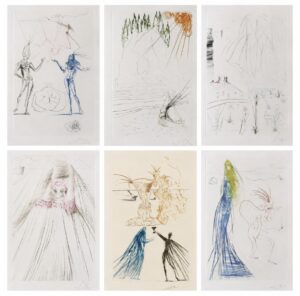
Why Was Salvador Dali’s Version of Tristan and Iseult Different?
The illustrated book: Salvador Dali text by Andre Mary, publisher Editions Ramos Anstalt 1969/70. Dali radically took apart the traditional context of the Tristan and Iseult myth through his illustrations by replacing standard medieval romanticism with an unpredictable, psychoanalytic lens using his illustrations. While classical illustrators historically depicted the tale as a tragic, idealistic fable of chivalry, courtly virtue, and external misfortune, Dali reinterpreted the narrative through basic shifts that expressed internal madness:
The standard folklore treats the magical love potion as an accidental plot device or a twist of fate. Dali, heavily influenced by Freudian theory, reimagined the potion as a violent psychological substance that instantly breaks the conscious ego, stripping away rational human control to expose the raw, primitive feelings of the unconscious mind. Traditional art frames the lovers’ bond as a perfect, harmonious romance, but Dali used his signature paranoiac-critical method to portray their passion as a hostile, undermining crisis. This psychological friction reached its peak in his avant-garde ballet adaptation, where the knight’s mental deterioration causes him to perceive his beloved not as a delicate princess, but as a predatory praying mantis destined to physically and spiritually devour her partner.
Rather than attaching the story inside period-accurate castles or ornate medieval courts, Dali mapped the tragedy across desolate, dreamlike landscapes filled with unique iconographic shorthand. He imagined their inescapable bond by drawing their hands as gnarled, skeletal tree roots clawing toward one another across a barren desert, translating the traditional folklore of the intertwined trees growing from their graves into an immediate, living physical deformity. Where classical artists focused on intense facial expressions to convey heartbreak, Dali stripped the characters of their basic anatomy to emphasise psychological alienation; for instance, he depicted Tristan’s second wife as an inanimate, trophy-like object completely devoid of facial features or arms, externalising the hero’s internal emptiness and lack of emotional fulfilment. While others told the story on a flat canvas, Dali pulled the myth into a multi-sensory dimension by tightly blending his visuals with the gruelling climaxes of Wagnerian music, ensuring the final dual demise felt less like a quiet medieval tragedy and more like a disastrous psychological collapse.
The legend of Tristan and Iseult is a monumental 12th-century medieval romance that serves as the ultimate blueprint for tragic, star-crossed love stories across Western literature. The narrative centres on a brave Cornish knight who accidentally drinks an unbreakable love potion alongside an Irish princess who is destined to marry his own uncle, King Mark. This single, magical mistake instantly fuses their souls together in a passionate, agonising bond that forces them into a treacherous life of secret trysts and heartbreaking betrayal against the crown. Their inevitable exile culminates in one of folklore’s most haunting conclusions, where a jealous, misplaced lie causes Tristan to die of pure despair seconds before a devastated Iseult collapses and dies of a broken heart by his side. It was precisely this hallucinatory, overwhelming connection of erotic obsession and fatal destiny that captivated Salvador Dali, inspiring him to translate their mythic agony into his ultra-rare 1969 suite of chaotic, surrealist etchings.
Salvador Dali visualised the legend of Tristan and Iseult not as a sweet, idealised fairytale, but as a primal, psychological hurricane that mirrored his own subversively intense relationship with his wife and muse, Gala. Heavily influenced by Sigmund Freud’s psychoanalytical theories, Dali viewed the magical love potion not as an accidental misfortune, but as a sudden, violent awakening of the unconscious mind that instantly strips away rational human control. He famously channelled this chaotic energy into his 1944 ballet adaptation, Mad Tristan, where he infamously depicted a love so fiercely all-consuming that the maddened hero begins to perceive his beloved as a praying mantis ready to devour her partner.
To physically represent this overwhelming passion on a personal level, Dali designed a unique gold jewellery brooch where two profile heads seamlessly juxtapose to form a singular goblet, visually illustrating how two distinct identities can melt into a shared, intoxicating vessel of love. For Dali, the mythic connection between love, madness, and fatal destiny was a lived reality; he spent his later years courting Gala like an idealised medieval knight before ultimately dying in 1989 while listening to his absolute favourite recording of Richard Wagner’s Tristan und Isolde opera.
In the drypoint engraving titled Frocin the Bad Dwarf, Salvador Dali masterfully separates the precise moment of rising paranoia and incoming betrayal as the conniving court dwarf plots to catch the adulterous lovers in the act. The composition centres on a tall, elegant, yet deeply distorted figure of Iseult looking toward a massive, imposing stone monolith that functions as a recurring monument of tragic transition throughout the series. This ominous stone serves as a visual gateway representing a permanent passage from one state of life to another, hinting at the fatal destiny waiting for her at the end of the narrative arc. In a brilliant execution of surrealist subversion, the treacherous dwarf is depicted standing nearby while clutching a single flower in his palm. Rather than an offering of beauty, this flora serves as a raw metaphor for Iseult herself, visually symbolising the villain’s absolute control over her secrets and her looming exposure to the king. The entire scene allows Dali to surround the characters with chaotic, web-like textures and rubbed shadows. This intricate printmaking technique effectively strips away the calm, romantic setting of a traditional medieval palace court, replacing it with an anxious environment heavy with the suffocating psychological weight of being watched. By relying on landscape, scale, and symbolic shorthand instead of standard theatrical expressions, the artist proves that the characters are completely swallowed by their fixed tragedy.
In stark contrast to Salvador Dali’s drypoint etching of Frocin as a monstrous, hunched ghoul, Serge Ivanoff approached the dwarf through the refined lens of classical realism and mid-century theatrical grace. For his nineteen-sixties edition, Ivanoff completely bypassed the vast surrealist empty voids and melting environments favoured by the Spanish master. Instead, he grounded the scene in a beautifully rendered, realistic medieval setting, depicting the treacherous character not as an abstract psychological distortion, but as a fully fleshed-out human antagonist operating within a physical space. Ivanoff utilised smooth, colour palettes and brushwork to isolate the tension of the scene. Rather than transforming Frocin’s physical anatomy into a display of internal rot, Ivanoff relied on dramatic lighting, precise body language, and historically accurate costuming to convey the dwarf’s calculated, narrative malice. Through this elegant execution, Ivanoff presented the betrayal as a sweeping, grand human drama, treating the villain as an organic piece of a traditional historical epic rather than a sudden crack of the conscious mind.
In his definitive nineteen-fifties French edition, Jean Chieze took an artistic path that directly opposed Salvador Dali’s intricate, nervous drypoint scratchings by crafting bold, primitive, and heavily graphic original woodcuts. This particular printmaking technique was chosen to intentionally mimic the raw, architectural aesthetic of twelfth-century medieval manuscripts, inserting the narrative within a historically grounded structure. Rather than translating internal psychological trauma, portraying the characters as predatory insects, or creating vast surrealist voids, Chieze’s full-page illustrations and detailed drop-cap initials focused on absolute formal stability and clean geometric balance. His depictions of the tragic narrative milestones relied on dense, hand-carved textures, heavy outlines, and rigid architectural framing to transform the story into a striking, black-and-white historical epic. Through this blockish and primitive medium, Chieze treated the mythic love story as a monumental piece of ancient folklore, completely eliminating the fluid, melting, and frantic paranoia that defined Dali’s twentieth-century psychological crisis.
In his restricted nineteen-fifties luxury printing of the text, French master Maurice Mourlot introduced a distinctly tender, atmospheric sensibility that operated as a direct visual antidote to Salvador Dali’s aggressive, nightmarish textures. Mourlot used original, multi-layered colour lithographs to portray the ancient legend in soft, poetic masterpieces, favouring expressive, sweeps of colour over the frantic, razor-sharp intaglio lines characteristic of the surrealists. Rather than seeking to break the viewer’s conscious mind through Freudian subversions, illustrations leaned into rich stone textures and quiet harmony. This deliberate choice isolated the deep, intimate melancholy shared between the characters, grounding the timeless tragedy within a serene, postwar European aesthetic that ranked emotional vulnerability over psychological devastation. By replacing immense voids with intimate, atmospheric landscapes, Mourlot treated the forbidden bond not as a lethal, devouring illness, but as a deeply human, beautifully mournful romance.
The Freudian Lens and Psychological Storm
Salvador Dali radically rejected the passive sweetness of traditional medieval instead, he viewed the story of Tristan and Iseult as a violent mental crisis. For Dalí, the love potion was not a magical plot device, but a symbol of how human self-control can suddenly shatter. He did not see their sea voyage as a real trip, but as a scary journey into the human subconscious.
Dali stripped away old-fashioned romance to show the harsh reality of an obsession. In his view, the lovers were not victims of bad luck, but prisoners of a deadly attraction they could not control. He used his unique artistic style to make mental delusions feel entirely real.
The story’s themes of guilt and betrayal gave Dalí the perfect backdrop to explore deep human anxieties. He believed the real tragedy was not being banished from a kingdom, but the internal torture of their forbidden passion. Instead of peaceful landscapes, he filled his art with a sense of doom, showing how raw desire can destroy society’s rules.
Instead of drawing normal people crying, he draws Tristan and Iseult as melting, fluid shapes dissolving into a barren desert. This empty landscape represents the mental void left behind when lovers are forced apart.
The Masterpiece strips away the courtly grief of classical illustrations, instead depicting the figures of Tristan and Iseult as melting, fluid anatomical structures that appear to melt into the desert.
This empty landscape represents the scary desolation felt when a deep obsession is forced apart by society’s laws.
Dali uses the rough, scratchy texture of his engraving to surround the lovers with sharp, chaotic lines and deep shadows. These dark elements mimic the frantic, racing thoughts of a mind in crisis.
To capture the devastating heartbreak of The Separation of the Lovers, the prominent illustrators working during Salvador Dali’s mid-century era completely rejected Dali’s style of bodies melting, they chose instead to capture the heartbreak by using realistic human proportions, a dignified structure, and a quiet, poetic mood.
Russian-born master Serge Ivanoff approached the emotional trauma of the exile through a highly calculated lens of classical realism and mid-century theatrical balance. Ivanoff completely bypassed Dali’s shock method choosing to illustrate the parting of Tristan and Iseult as a grand, human-scaled historical tragedy, using brushwork and smooth, colour palettes to separate the two lovers. His illustrations focused heavily on the intense, naturalistic expressions of grief written across the characters’ faces, using dramatic theatrical lighting and realistic costumes to show the heavy burden of their duty to the King. Through this highly refined execution, Ivanoff treated the separation as an organic, heartbreaking milestone within a traditional historical epic, ensuring that the characters retain their bodies rather than melting into different forms.
In his nineteen-fifties French edition, Jean Chieze designed his illustration of The Separation to look like a permanent, unyielding monument of ancient folklore. Chieze took a path that directly opposed Dali’s drypoint marks by using bold, heavily graphic original woodcuts that mimicked the primitive aesthetic of twelfth-century manuscripts. Instead of showing mental trauma or turning the figures into skeletons, Chieze uses solid architecture, placing a harsh castle wall or heavy gate directly between the characters. This medieval style makes their exile more realistic. It completely removes the melting shapes, and psychological terror found in Dalí’s modern version.
French painter and lithographer Maurice Mourlot brought a tender, beautifully subdued postwar European sensibility to this tragic story. He used colour lithographs with smooth brushstrokes and rich textures to fill the scene with desolation.
Mourlot did not try to shock viewers with Dalí’s disturbing psychological symbols or crutches. Instead, his soft, poetic artwork focuses on the deep, quiet vulnerability of the couple as they look at each other for the last time. By replacing Dali’s scary, empty spaces with gentle areas of colour, Mourlot shows the end of their love not as a deadly disease, but as a deeply human and beautifully sad romance.
The Muse, Gala, and Real-Life Parallels
Dali directly projected his own intensely complex relationship with his wife, Gala, onto the mythic figures of the text to merge reality with fiction. He genuinely saw himself as a flawless, highly eccentric knight eternally bound to a powerful, mesmerising, and occasionally terrifying queen who held his sanity in her hands. The subversive process of the legend’s complex love triangle directly mirrored Dali’s personal, real-world exploration of societal taboos, extreme romance, and total artistic devotion. For the eccentric painter, Gala was simultaneously the magical healer of his deep-seated psychological wounds and the absolute chief draftsman of his creative madness. He frequently and intentionally infused his depictions of Iseult with the sharp, commanding, and fiercely protective presence that defined his real-life Russian muse. The haunting idea of a love so fierce it actively threatens to completely consume the individual identity was a lived, daily reality inside Dali’s private refuge. He continuously courted his wife with the exact same theatrical, larger-than-life dedication that the legendary medieval knights reserved for their royal, courtesans. Dali used his fine art publications to immortalise his personal romantic philosophy under the clever guise of an ancient, universally accepted fable. He used the legendary lovers to safely show his deepest, most obsessive desires to the world.
In the drypoint engraving titled Iseult’s Triumph, Salvador Dali crafts a profound, visually striking parallel between the medieval Irish princess and his own absolute, real-life leader, his wife and muse Gala. The illustration rejects the idea of weak, submissive women. Instead, it places the main female character on a huge pedestal that takes over the whole scene. He was trying to reflect Gala’s personality in the sketch her using heavy, geometric lines. Dali obviously felt submissive to his wife as she was the stronger minded one who looked after his mind and his money, hence the bowing at her feet in the illustration.
The Praying Mantis and Dark Material Metaphors
In a truly shocking departure from classical illustration techniques, Dali famously and subversively conceptualised the maddened knight as perceiving his beloved as a predatory, cannibalistic praying mantis. his terrifying insect metaphor showed his belief that total, unrestricted obsession completely devours a partner.
To show Tristan’s mental collapse, Dalí dressed the bleeding, upset knight in an absurd dandelion hat that suggested extreme fragility. He also designed a solid gold brooch where two faces merged to form a single cup. This cup showed how two separate identities can completely melt into one dangerous vessel.
Dalí transformed the lovers’ hands into twisted tree roots clawing toward each other across a barren desert. These skeletal branches hinted at the legendary, intertwined trees that would later sprout from their graves.
In the drypoint engraving titled Tristan’s Madness, Salvador Dali broke away from traditional art forms by sketching the mad Knight looking at his lover as a praying mantis to show his belief that obsession that is allowed to fester can completely devour their partner.
In revealing Tristan’s mental collapse, Dalí dressed the bleeding, distraught Knight in a dandelion hat to show his fragility. The gold brooch showed two faces merge to form a single cup. This cup showed how two separate identities can completely melt into one treacherous pot.
Dali transformed the lovers’ hands into twisted tree roots clawing toward each other across a barren desert. These skeletal branches hinted at the legendary, intertwined trees that would later sprout from their graves.
The Theatrical Masterpieces and Wagnerian Obsession
Dali’s deep, lifelong obsession with the tragic tale initially drove him to write and design the avant-garde sets for his remarkable mid-century ballet titled Mad Tristan. The colossal canvas backdrop he painted depicted a highly tortured, surreal world. This was his first official ballet. To elevate the high-fashion production into an elite realm of absolute luxury, legendary designer Coco Chanel was personally brought in to hand-sew real fox fur and precious stones into the actors’ costumes. The entire avant-garde choreography was brought to life on the New York stage through a close, intense, and highly volatile collaboration with Russian maestro Leonide Massine. Dali completely built the entire performance around the dramatic and emotionally exhausting climaxes of Richard Wagner’s celebrated operatic score. The German composer’s monumental musical concept of Liebestod, or the sacred love-death, acted as the definitive, guiding soundtrack to Dali’s entire creative production during this era. The artist spent countless hours locked away in his private studio, frantically painting to the dramatic melodies of the opera to capture the intensity onto his canvas. This resulted in a beautifully poetic, sorrowful end when Dali passed away from heart failure. His absolute final moments on earth were spent quietly listening to his favourite recording of Wagner’s opera echoing inside his custom museum in Figueres.
In the definitive final drypoint engraving titled Tristan’s Testament, Salvador Dali brings together his love for the theatre and the music of Wagner on a monumental scale by depicting the lovers’ deaths as if they are melting from the sound of an imaginary orchestra rather than showing them on a silent and still deathbed as was done traditionally in Medieval art.
In my opinion looking through Dali’s Tristan and Iseult book is a hauntingly beautiful. Andre Mary’s elegant prose sets a classical stage, and Dali’s etchings in contrast bring a chaotic madness to the words. It is a brilliant testament to what happens when timeless mythology is unapologetically hijacked by pure, surrealist madness.
The Ultra-Rare Limited Portfolio
Nearly a quarter-century after his celebrated ballet production, Dali returned to the myth to publish an elite, ultra-luxurious, and highly limited-edition suite of colour drypoint etchings. Written by Andre Mary and published simultaneously across continents, the magnificent and imposing portfolio remains a true, undisputed pinnacle of twentieth-century printmaking and book production. The complete masterwork comprises a superb set of intricate intaglio prints that tell the tragic story from the fateful love potion to the final dual demise. Dali purposefully restricted the total global release of the main French edition to a small print run of numbered copies. These were also deluxe copies that had an extra suite of all the etchings, with every individual plate hand-signed or initialled in pencil by Dali himself. The physical book was presented as a loose-leaf folio elegantly housed in a lavish leather folder boasting an original, sculptural metal cover designed collaboratively by Gala and Dali. As many of these historic, museum-grade volumes were aggressively broken up by unscrupulous art dealers over the decades to sell the prints individually, intact sets are exceptionally rare today. Finding a pristine, completely intact first edition inside its original protective leather clamshell box commands a staggering, elite premium on the international collector’s market. A copy is currently listed for £62,500 at Peter Harrington Rare Books.
At the time he was creating the Tristan and Iseult engravings, Salvador Dali was at the peak of fame even though his reputation was at its lowest. To elite museums and serious twentieth-century art historians, the ageing master was largely dismissed as a commercial sellout who had traded his avant-garde genius for television game-show appearances and theatrical publicity stunts. This widespread institutional contempt was further aggravated by a chaotic print market scandal, as his late-career circle flooded the market with mass reproductions that caused serious galleries to look at his limited-edition books with intense suspicion. Since his death, however, Dali’s position on the art history ladder has undergone a spectacular rehabilitation, rescuing his legacy from that of a gimmicky showman to an unassailable titan of modernism. Rigorous cataloguing successfully separated verified, elite masterworks, like this authentic 1970 portfolio, from the fraudulent late-career posters, sparking massive surges in financial value for intact, pristine sets. Today, his finest interwar oils have skyrocketed into the multi-million-pound trophy asset tier, ensuring that his rare luxury books are treated with the exact same museum-grade reverence as a Picasso or a Matisse.