
25 Cats Name Sam and One Blue Pussy
Andy Warhol’s Cats and the Underground Gay Scene of 1954
The Book
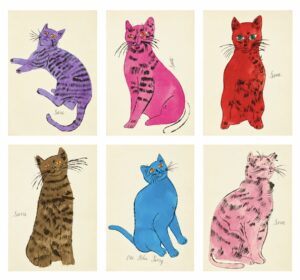
25 Cats Name Sam and One Blue Pussy, by Andy Warhol, published by Seymour Berlin in 1954.
In 1954 a brutal war was waged against the gay community in America. The Senator Joseph McCarthy forced gay and lesbian individuals from all federal positions. Police were routinely raided bars and restaurants, in their bid to clean up the city of immoral degradation. Every gay man and woman feared the police and the consequences of being discovered that they remained at home. This fear became known as the “Lavender Scare”. The artist and illustrator Andy Warhol was one of these individuals who feared being discovered by the State as being gay. Inside his 75th Street apartment where he lived with his mother and his abundance of cats, he self-published his 25 Cats Name Sam and One Blue Pussy in defiance of the State sanctioned paranoia. The word ‘pussy’ in the title which was a well-known sexual slang word but Warhol got away with it due to the book being about cats.
The Lavender Scare and Legal Erasure
Homosexuality was classified as a psychiatric disorder as it made individuals prime targets for Soviet blackmail. Suspected homosexuals enforced strict laws in New York, under the State Liquor Authority which prohibited establishments from serving alcoholic drinks to suspected or known homosexuals. They could not gather in a public place and to do so was a criminal offence. During the 1950’s under the Lavender Scare, Andy Warhol was able to disguise his private life by working as a fashion illustrator for big department stores and mainstream magazines. This lucrative job was seen as clean-cut and as he was seen as an elite eccentric who was highly sought after in the fashion industry so he was not deemed a threat to the State.
He could not meet up with his homosexual acquaintances for fear of being arrested by the Vice Squad as he would have lost his personal freedom and his working contracts. So, how he overcame this was to invite his friends over to his place for colouring parties where his guests tinted his illustrations by hand for his self-published book called 25 Cats Name Sam and One Blue Pussy.
Clandestine Spaces and Coded Survival
The heavy policing of gay nightlife during this time operated entirely in the shadows, concentrated heavily around Greenwich Village.
- The Nightlife: Hidden bars were frequently managed by mob syndicates who paid off corrupt local police precincts to stave off sudden raids, though patrons always remained a single police raid away from public exposure, career termination, and social ruin.
- The Codes: Community survival outside of bars depended on a system of public cruising areas, such as around the Hudson River and Central Park.
The Aggressive Masculinity of the Art World
The elite classes of the New York art market during Warhol’s early career were profoundly hostile toward openly gay expressions during the 1950’s as Abstract Expressionism was the art form that was in style. This movement portrayed the rugged, hyper-masculine, and tortured personas of figures like the artist Jackson Pollock. Warhol did not try to hide his effeminate demeanour, soft-spoken nature, and background in commercial fashion illustration caused the straight art establishment to dismiss him outright using the derogatory label “swish.” Strikingly, even closeted contemporaries like Jasper Johns and Robert Rauschenberg chose to distance themselves from Warhol during this period, deeply anxious that his overt campiness and refusal to mask his effeminacy would compromise their own professional survival in a homophobic industry.
where individuals relied entirely on subtle sartorial signals, coded dialogue, and brief glances to safely identify one another.
Domesticity as Radical Defiance
Ostracised by the dominant galleries, gay creatives formed insular, fiercely loyal micro-communities to sustain their work. They gathered at private loft parties to colour prints, collaborate on underground magazines, and finance independent projects. In an era that demanded absolute aesthetic and social conformity, turning away from macho canvas painting to create whimsical, delicate books about cats and male beauty was a profound, highly strategic reclamation of personal identity.
The deployment of highly organised plain clothes entrapment tactics by the New York City Police Department’s Vice Squad during the mid-1950s served as a weapon of state terror, systematically manufacturing crimes to arrest gay men and inducing a state of permanent paranoia that directly dictated how Andy Warhol and his contemporary circle survived.
The Mechanism of the Undercover Trap
Operating as agents provocateurs, plainclothes officers blended seamlessly into civilian spaces to aggressively bait unsuspecting individuals:
- The Calculated Flirtation: Attractively dressed undercover decoys infiltrated known bohemian lounges, Greenwich Village taverns, and urban cruising corridors like Central Park, intentionally initiating charming conversations, offering drinks, and subtly escalating the dialogue toward intimacy until the target gave a verbal assent, triggering an immediate arrest for “lewdness” or “solicitation.”
- Fabricated Compliance: Vice squad operators frequently manipulated environments in public bathhouses, gym locker rooms, and transit restrooms by initiating provocative physical cues, subsequently arresting any man who either reciprocated the gesture or merely lingered too long in the vicinity.
- The Weapon of Public Exposure: The true malice of the entrapment system lay in its catastrophic social consequences, as the NYPD routinely forwarded the names, vocations, and residential addresses of the accused to local media outlets, ensuring instant occupational termination, eviction, and total social excommunication.
The Direct Impact on Warhol’s Artistic Circle
Forced to navigate this dangerous landscape of state-sponsored surveillance, Warhol and his fellow gay creatives adapted by retreating into tightly guarded, domestic networks where they could express their true identities through coded artistic mediums. Because public commercial establishments were compromised by undercover decoys, Warhol shifted his creative and social life entirely behind the locked doors of his private apartment, hosting collaborative “colouring parties” where friends could hand-tint his self-published books like 25 Cats Name Sam and One Blue Pussy. Channelling their creative energy into delicate, hyper-feminine illustrations of domestic felines and fashion motifs was a calculated survival mechanism, allowing them to celebrate a camp, gay aesthetic entirely insulated from the predatory reach of the Vice Squad. Because Andy Warhol never maintained an official production ledger during his formative years as an illustrator, the exact assembly of individuals who wielded paintbrushes at his kitchen table fluctuates, yet historical records point to a specific, fiercely loyal inner circle of artistic collaborators, early assistants, and confidants who manually applied the vibrant watercolour washes to the cat portfolios. These names include:
- Nathan Gluck who operated as Warhol’s foundational pre-Pop studio assistant, Gluck was an exceptionally talented artist who managed commercial illustration deadlines while masterfully organising the logistical flow of the evening watercolour sessions.
- Vito Giallo, a trusted studio assistant and influential figure in the underground art scene, Giallo managed the avant-garde Loft Gallery and actively participated in the meticulous printmaking and hand-tinting processes inside the apartment.
- Charles Lisanby: A prominent television set designer and Warhol’s deeply significant romantic obsession of the mid-1950s, Lisanby was officially credited on the book’s colophon page because he conceptualised the grammatically flawed title 25 Cats Name Sam and One Blue Pussy.
- Clint Hamilton, A charismatic young commercial designer from Texas who shared a close artistic bond with Warhol, Hamilton frequently partnered on major New York department store window displays and regularly joined the domestic colouring sessions.
- Seymour Berlin, while his primary business role was physically running the specialised offset lithography presses to print the raw black-and-white plates, Berlin was a deeply trusted confidant who routinely embedded himself in the day-to-day production of Warhol’s private art portfolios.
- Julia Warhola, Warhol’s eccentric, fiercely supportive mother who cohabited the apartment with the real-life colony of felines, she not only painstakingly penned the book’s distinct, looping cursive calligraphy but also actively participated in the domestic painting assembly line alongside her son’s bohemian friends including the title to which Warhol kept as it was with the error ‘name’ cats instead of changing it to ‘named’ cats as she her native language was Rusyn which is an East Slavic language related closely to Ukrainian.
Coded Desires via Wallowitch
Warhol’s intimate relationship during this period with the brilliant young photographer Edward Wallowitch heavily influenced this need for visual obfuscation; Wallowitch’s photography masterfully captured the quiet, veiled, and melancholic realities of closeted urban life. Warhol directly utilised Wallowitch’s prints as tracing templates for his iconic blotted-line technique, transforming explicit, forbidden gay yearning into soft, ambiguous commercial sketches that could pass entirely beneath the radar of homophobic authorities. The technical evolution of Coded Desires via Wallowitch serves as the precise conceptual blueprint that allowed Andy Warhol to construct the whimsical universe of 25 Cats Name Sam and One Blue Pussy. It marks the defining moment where the artist elevated the act of tracing from a mundane advertising trick into a highly sophisticated, defensive mechanism for creative survival.
While Warhol did not directly lift Edward Wallowitch’s photographic portraits of young men to create the cat illustrations, the two projects are inextricably bound by the development of the blotted-line technique. The mechanical assembly system used to render the felines was forged through his work with Wallowitch’s street photography. The immense terror of a career-ending police entrapment created deep, self-protective rifts among gay artists of the era, most notably driving a wedge between Warhol and the rising stars Jasper Johns and Robert Rauschenberg. Johns and Rauschenberg, who meticulously managed their own closeted public personas to achieve mainstream gallery success, actively shunned Warhol because they viewed his overtly effeminate, “swish” demeanour as a severe liability, fearing that proximity to his unmasked campiness would attract the scrutiny of undercover police and instantly collapse their lucrative art world sponsorship.
This early, hostile environment forced Warhol to perfect the ultimate survival skill: wrapping deeply subversive, gay, and transgressive themes inside an entirely non-threatening, hyper-commercial veneer, a defensive strategy of hiding in plain sight that would eventually lay the conceptual foundation for his global Pop Art revolution. By using an early projector to cast a concrete image onto non-absorbent paper, tracing it in wet fountain pen ink, and pressing it onto a second sheet, Warhol intentionally broke down the realism of the original subject. The resulting irregular, splattered transfer lines stripped away any sense of a raw, literal document, whether it was a forbidden, homoerotic photograph or the chaotic movement of his real-life colony of Siamese cats, and replaced it with a detached, commercial texture. If tracing Wallowitch’s images in subsequent works like A Gold Book (1957) allowed Warhol to capture forbidden gay desire on paper, the 1954 cat portfolio functioned as the structural shield that made that exploration possible. By embracing the camp, domestic archetype of the cat, he could defiantly reject the straight art world’s macho expectations while using a technique that looked safely decorative. By using a process that mimicked mass production, Warhol successfully flattened the deeply personal aspects of his private life, his intimate collaborative bond with Wallowitch and his domestic routine with his mother, into “charming illustration work” for high-end boutique clients. Ultimately, the technical habits Warhol perfected through tracing Wallowitch’s photography provided the vital blueprint for 25 Cats. This process taught him that by using mechanical repetition to flatten an image, an artist could successfully hide deeply radical, gay, and transgressive secrets directly in plain sight.
The severe reality of mid-century state terror fundamentally transformed how Andy Warhol approached the very concept of art, forging the iconic, protective mask that would eventually define his legendary Pop Art revolution in the decades to follow. Forced to hide his true self from the predatory gaze of the NYPD Vice Squad, Warhol learned early on that the safest way to express forbidden gay identity was to wrap it entirely inside a non-threatening, hyper-commercial veneer that straight society would readily accept without question. The whimsical felines of his 1954 portfolio were never just innocent drawings; they were a highly strategic dress rehearsal for hiding in plain sight, proving that a marginalised artist could successfully construct a beautifully stylised sanctuary right under the nose of a paranoid nation. Warhol had to market the books under the radar.
- 16 illustrations of cats inside the book (each inscribed with the name “Sam”).
- 1 illustration of the “One Blue Pussy”.
- 1 illustration printed for the cover / title page
Despite maintaining a highly visible lifestyle and consistently pushing legal boundaries with his sexually explicit, homoerotic drawings and transgressive avant-garde underground films, Andy Warhol completely managed to evade personal arrest by law enforcement throughout his entire career. Andy Warhol’s reluctance to publicly identify as a gay man was a calculated strategy for survival during an era of state-sanctioned persecution and professional blacklisting. By channelling his gay identity into his art rather than making a public declaration, he successfully navigated the hostile social landscape of mid-century America. During the period when he produced the book consensual adult homosexual acts (prosecuted under sodomy statutes), under New York State law in 1954, carried a maximum legal sentence of six months in prison. While New York had actually made history in 1950 by becoming the first state to downgrade private, consensual adult sodomy from a felony to a third-degree misdemeanour, the absolute devastation of getting caught went far beyond the six-month jail term.
If Andy Warhol or his friends had been caught by the NYPD Vice Squad, the actual real-world “sentences” would have been catastrophic as the NYPD systematically leaked the names, home addresses, and employers of those arrested to local newspapers. For a successful commercial illustrator like Warhol, a public arrest record would have meant the instant loss of all his corporate advertising clients and department store contracts. Under President Eisenhower’s Executive Order 10450, homosexuality was classified as a national security threat and a mental illness. An arrest would ensure a permanent ban from any government work, academic positions, or mainstream institutional funding. Getting arrested for “solicitation” or “disorderly conduct” often meant instant eviction by landlords, being permanently disowned by family, and facing targeted police harassment for the rest of your life.
When his career transitioned into the chaotic, drug-fuelled underground scene of The Factory during the 1960s, Warhol mastered the role of the detached observer. While his studios were populated by radical counterculture figures and his films depicted highly illegal acts, Warhol himself remained a sober cameraman who rarely participated in the vices surrounding him. When local precincts occasionally raided his avant-garde film screenings or targeted his entourage, it was almost always his actors, superstars, or groupies who faced the legal consequences and took the fall, leaving the artist himself untouched. Ironically, Warhol’s most significant interaction with the police did not involve him breaking the law, it occurred on June 3, 1968, when law enforcement had to be called to protect him after he was shot and nearly assassinated by radical writer Valerie Solanas inside his own studio.
Instead of conventional paragraphs or descriptions, the “text” within the pages of the book consists purely of the single word “Sam” written over and over again in elegant cursive calligraphy. Each individual cat illustration is accompanied by this lone, handwritten name, completely omitting any narrative, poem, or story structure which helped keep him under the radar. Also, instead of using traditional retail stores or paid advertisements, Andy Warhol promoted 25 Cats Name Sam and One Blue Pussy through an intimate, grassroots strategy designed to network directly into New York’s elite fashion and publishing circles. He transformed the self-published volume into a luxury promotional keepsake, personalising and gifting copies to powerful art directors at magazines like Vogue and Harper’s Bazaar. By presenting the book as an exclusive Christmas or thank-you token, he ensured his unique “blotted line” technique landed directly on the desks of the city’s key tastemakers and potential commercial clients.
To elevate the book’s prestige, Warhol timed its release alongside his personal illustration exhibitions at New York’s Bodley Gallery, framing the pages as collectible fine art rather than mere portfolio samples. He further generated organic word-of-mouth buzz by hosting informal “colouring parties” at Serendipity 3, a trendy Upper East Side cafe. By gathering friends, clients, and acquaintances to hand-colour the lithographs over drinks, Warhol turned the production of the book into a fashionable social event that naturally amplified its reputation throughout the city’s creative scene.
This repetitive layout was incredibly strategic for Warhol’s marketing goals. Because the text was reduced to a simple, uniform name tag on every page, it functioned less like a book to be read and more like a high-end commercial portfolio. It kept the viewer’s focus entirely on his visual style, line work, and hand-painted colour washes, turning a self-published art book into a subtle, memorable advertisement for his freelance illustration services.
When we look past the brilliant Campbell’s soup cans and vibrant Marilyn Monroe silkscreens of his later fame, we see the enduring legacy of a young man who survived the darkest years of the Lavender Scare by mastering the art of the camouflage. Ultimately, Warhol’s entire career became a profound, brilliant extension of those quiet evenings on East 75th Street, proving that while oppression can force a community into the shadows, true creative resilience will always find a way to brilliantly colour outside the lines. The illustrated book 25 Cats Name Sam and One Blue Pussy which was privately pressed by his trusted collaborator Seymour Berlin had a print run of just 190 numbered copies. Copy number 69 of the 190 limited edition copies was estimated at £50,000-£70,000 by Christie’s in March 2024 and sold for £88,200 on the day.