Rose Adler Book Bindings
How She Changed Tradition
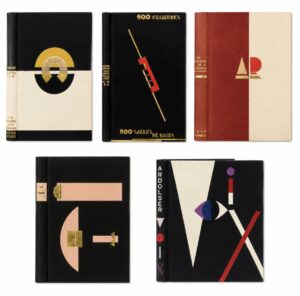
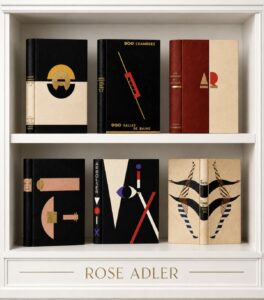
The images below show how bookshelves looked before Rose Adler transformed the very fine colourful bindings. Look how uniform the old books look in colours of brown. It must have been so difficult to find a particular book if you didn’t know where about on the bookshelf it was as they all look so similar. Rose Adler bindings brought books alive and she gave them uniqueness. You would want to pick up every book to have a closer look at the binding and examine each and every one closely to feel the texture as they draw you in. The binding makes you believe that the book inside must be riveting with the binding looking so special.

How Expensive Were Rose Adler’s Bookbindings?
Adler’s bookbindings were extraordinary expensive at the time, far exceeding the cost of a standard, traditional custom bookbindings. While a traditional fine leather binding in the 1920s was already a luxury service reserved for wealthy bibliophiles, Adler’s work operated at an entirely different tier of the art market. Her creations were not priced as mere library infrastructure, but as elite, high-end private art commissions.
Traditional binders primarily used uniform batches of calfskin or goatskin, which kept material costs relatively predictable. Adler, conversely, treated books like high jewellery. Her designs required purchasing genuine, highly expensive exotic reptile skins (lizard and crocodile), imported silks, and luxury metallics like palladium and raw aluminium. Furthermore, because she routinely embedded polished cabochons of authentic semi-precious gemstones, such as jade, agate, and lapis lazuli, directly into the structural core of the book boards, the raw material cost alone far outpaced traditional binderies.
Adler’s complex geometric arrangements relied on incredibly meticulous, labour-intensive techniques like scarf-jointed inlays and micro-shaved leather onlays. Because her blueprints demanded mathematical perfection to fit the mosaic-like leather pieces together seamlessly, the assembly took weeks of intense, manual labour. As her career scaled, she had to contract elite master forwarders and finishers, such as Emmanuel Lecarpentier and Adolphe Cuzin, to execute her highly precise blueprints. Paying for multiple top-tier master craftsmen to complete a single volume inflated the final price significantly.
Adler’s primary client base consisted of ultra-wealthy, avant-garde collectors who were willing to pay a premium for uniqueness. Her career was launched and sustained by the legendary French fashion designer and collector Jacques Doucet, who hired her to bind premier editions for his private collection alongside furniture designed by Eileen Gray. Because Adler specifically designed each binding to be a completely unique, one-of-a-kind abstract interpretation of that specific text, she never replicated a pattern. Collectors were not just paying for a covered book; they were purchasing an exclusive, unrepeatable piece of the French Art Deco movement.
How Other Reacted to Rose Adler’s Bindings
The arrival of Rose Adler’s avant-garde bookbindings in the 1920s sent shockwaves through the conservative bibliophile community, provoking a polarising mix of deep professional scepticism, public fascination, and eventual institutional reverence. Traditionalists who spent their lives treating a library as a uniform, silent wall of gold-leafed family crests and dark Morocco leather viewed her structural innovations as a radical, almost sacrilegious departure from historic craftsmanship.
Her supporters, most notably the legendary couturier and ultimate patron Jacques Doucet, countered the traditionalists by demonstrating that her designs actually honoured the literature. While traditional bindings kept the outside completely detached from the writing inside, Adler’s work forced the old guard to realise that a cover could “marry and glorify” the text. When collectors saw how her kinetic inlays physically echoed the rhythms of modern poetry or avant-garde prose, the traditional argument that her work was just a passing gimmick began to fall apart.
Rose Adler’s enduring artistic legacy lies in her radical redefinition of the book as a three-dimensional canvas, single-handedly rescuing a centuries-old utilitarian craft from institutional stagnation and elevating it into the realm of high avant-garde art. By insisting that a volume’s exterior must actively serve the psychological rhythm and emotional soul of the literature inside, she permanently shattered the traditional, uniform boundaries of design and introduced a bold, graphic vocabulary that forever changed how we interact with printed text. Her daring structural experiments, whether seamlessly weaving exotic reptilian skins with raw cork, embedding polished semi-precious gemstones into book boards, or using industrial metals like raw aluminium to create reflective, modern typography, proved that a book cover could function as a profound work of abstract sculpture rather than a mere protective shield. Ultimately, by forcing the most conservative cultural institutions of Europe to recognise her flawless technical execution and revolutionary vision, Adler did not just create beautiful bindings for the elite libraries of her day; she successfully built a bridge between historic craftsmanship and modern artistic expression, securing her place as an uncompromised pioneer of twentieth-century design whose influence still echoes through modern book arts.
Rose Adler’s Book Bindings Today
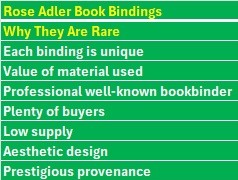
- Market Rarity and High-End Pedigree: Adler treated each project as an entirely unrepeatable, bespoke concept, meaning her absolute output was highly limited compared to commercial binderies. Furthermore, because her most legendary 1920s masterpieces were commissioned by titan taste-makers like the multi-millionaire fashion icon Jacques Doucet, her work possesses an ironclad provenance. In the high-end collectables market, a pristine Art Deco binding with an unassailable line of ownership tracing back to pioneering 1920s collections automatically commands a steep financial premium.
- Double-Asset Value Compounding: The unique mechanics of buying an Adler binding mean that a collector is investing in two distinct markets simultaneously. Over time, the value of the scarce, first-edition modernist texts she bound, such as rare printings of Guillaume Apollinaire, Arthur Rimbaud, and Rene Char, appreciated heavily on their own merits. When these already valuable literary first editions are paired with an intact, physically flawless piece of abstract Art Deco sculpture designed by Adler, the two assets compound one another, driving the total market value significantly higher than the text or an ordinary binding alone.
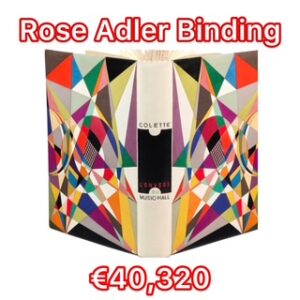
- Current Auction Performance: The long-term investment yield is directly reflected in modern fine book and manuscript auctions at global houses like Sotheby’s. While a standard, top-tier traditional leather binding from the 1920s might sell today for a few hundred or a few thousand pounds based on its technical utility, surviving Adler bindings routinely command staggering sums. Modern auction estimates and realised hammers for her delicate bindings consistently clear between €12,000 to €35,000 onwards, with highly rare combinations featuring original artwork from legendary creators like Pablo Picasso driving prices even higher. Her elevation by cultural institutions into the permanent history of modern design ensures that her bindings are no longer priced as mere books, but as prized artifacts of the twentieth-century avant-garde. A copy of L’Envers du Music-Hall, published by Au Sans Pareil in Paris in 1926 bound by Rose Adler with an explosion of colour was estimated by Christie’s, Paris in May 2025 for €25,000-€35,000 and it sold over the estimate at €40,320 on the day.