
Ulysses James Joyce
Valuable Banned Book
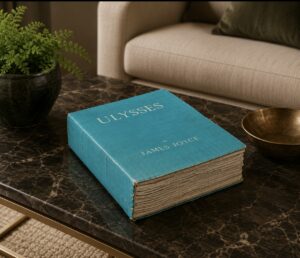
The Book
Ulysses, by James Joyce, published in 1922 by Shakespeare and Company.
Why is the first Edition of Ulysses by James Joyce So Valuable?
The first edition of Ulysses by James published in 1922 has been one to collect by private buyers including individuals and private organisations and public institutions like museums universities which has helped push up the prices steadily. But what makes this book so special that when one comes up for auction it sells exceedingly well. Here are the reasons why the first edition of Ulysses is so valuable.
Limited First Print Run
Sylvia Beach, an American who owned a book store and lending library in Paris published the first edition privately in Paris under her bookshop’s imprint, Shakespeare and Company, printing exactly 1,000 numbered copies. As the book contained strong obscene language which was banned in the United Kingdom and America during this time and no commercial publisher would touch it for fear of the consequences like being arrested and the books seized by the authorities. Sylvia Beach’s published the book privately meant she could distribute it privately to her subscribers at the time. Her subscribers were paying towards the cost upfront through their subscriptions she could not afford to have the books seized and burned.
The Deluxe Copies
The first 100 copies were signed by James Joyce on the limitation page and these are the ultimate sought after copies. They were printed on fine Dutch handmade paper which feels more heavier than the standard copies. These copies are larger than the copies and have bigger margins than the numbered 251-1000 which used a different paper.
Copies 101-250 are large format and unsigned and on French Arches paper. Copies 251-1000 are standard trade copies on less expensive linen paper.
The only people who could afford the deluxe copies were the wealthy and include Winston Churchill who was an avid book collector. Fellow authors who were friends purchased copies including Ernest Hemingway and W. B. Yeats.
From these 100 copies only two are known to have been inscribed by the author along with his signature on the justification page. An inscribed copy was estimated at Christie’s at $200,000-$300,000 in 2002 and it sold for $460,500 in October 2002.
An inscribed copy number 282 of the 1000 copies was estimated the same sale in 2002, at $70,000-$90,000 and it sold over the estimate at $119.500 at Christie’s.
Copy number 75 of the 100 deluxe signed copies sold for $138,600 in January 2005 at Christie’s. The book had been finely bound by Bayntun-Riviere.
Copy number 281 unsigned and bound in blue half-morocco was estimated to be worth €8,000-€12,000 and it sold for €30,240 at Christie’s in March 2024 despite it having some flaws including a damp stain and minor restorations. As the original blue paper cover and spine were preserved it held its value.
The Fragile Paper Covers
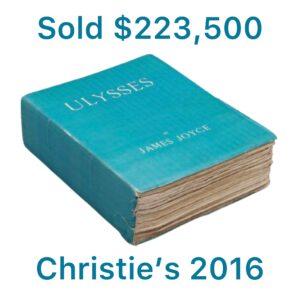
The original Aegean blue paper covers that match the colour of the Greek flag as Ulysses is from the Greek mythology and the Mediterranean Sea. To get the same colour as Joyce had requested the paper had to artificially dyed which left the cover being susceptible to fading. As the book in its natural state is quite fragile due to the number of sheets and the weight of the paper it is quite rare for a copy to come up for auction with a fine cover as you could imagine having been printed in 1922. The paper is quite thick and heavy and in order to hold the 732 pages together it had to be glued down for extra strength. Due to the fragility of the book as a whole and the price of the book some buyers had them professionally rebound in leather to protect them and make them more appealing. Some have the paper covers bound in which is always a bonus. Those which are left in the original paper covers have become increasingly scarce and valuable as paper covers get stained as readers tend to sit down with a hot drink and spills can happen. Sunlight results in fading paper cover on books especially on the spine as often only the spine is on view on a bookshelf. Paper covers are also prone to tearing and shelf wear.
Confiscations and Burnings
As the book was deemed ‘obscene’ by the State and banned in the USA and the UK, this led to customs seizing and burning the copies they managed to get hold of meaning there are fewer surviving copies from the total 1,000 copies of the first print run. There are around 800 surviving copies today with about half of these in public and institutional collections and the other half in private hands of collectors. Naturally, some may have been read over and over again until the book was worn away and thrown out but the deluxe copies being more expensive were more looked after by their owners and those whose hands they came into after their deaths.
Cultural Status
As later editions had the typos corrected be it over many decades, bit by bit, for various reasons, many agree that the original copy has held its cultural status along with the other reasons that make this first edition of Ulysses valuable. As the value has risen over the years many private collectors want to keep hold of them for investment.
Copy number one that belonged to the authors wife Harriet Shaw Weaver was donated by her to The National Library of Ireland in order that it be preserved is anticipated to worth €1000,000-€2000,000 if it came up for auction today and although this copy may never be sold in our lifetime it would be interesting to see how much this very personal copy would fetch.
What Was So Obscene About Ulysses by James Joyce
Leopold Bloom begins to masturbate while watching her. The combination of female sexual agency, voyeurism, and public masturbation was deemed completely unprintable by the courts, resulting in The Little Review editors being fined and the book being banned.
Chapter 15 termed ‘Circe’ is set in a brothel in Dublin’s red-light district where the characters Bloom and Stephen Dedalus participate in sadomasochism, gender-bending, cross-dressing, and provocative imagery of the Catholic Church.
Episode 18 called ‘Penelope’ was about Molly Bloom who talked about her menstruation and her sexual desires. She thinks about the physical details of her affair with Boylan, and describes male and female anatomy and the physical acts of sex. To 1920s censors, a woman openly celebrating casual infidelities and sexual pleasure without moral shame was quite shocking.
Why Do People Want to Read a Banned Book?
Most people wanted to read the banned book Ulysses because of the language, they had not read anything like it before so were intrigued. Reading about things that happen in everyday life like going to the toilet, menstruation, masturbation and sexual thoughts and acts was normal. The way it was written by Joyce in the manner he wrote it was the captivating part. Explicit and no-nonsense was James Joyce’s narrative made the book even more appealing.
Knowing a book is banned makes many people want to read it even more as they are curious to what is written that caused the ban in the first place. Getting your hands on a copy when it is banned seems like a thrill in its own that many people can associate with.
People also want a copy of the banned book to stand up for free speech as a sign of political rebellion against the censors who are basically telling the public what they can and can’t read. I would be one of those people as curiosity would get the better of me plus banned books often become valuable in future years because they were banned.
What Were the Censors Afraid of?
Victorian and Edwardian societal norms were built on the notion that women and young people possessed an innocent morality that needed to be protected. Censors feared that exposing them to the realities of sex, menstruation, and anatomy would strip away their innocence. By reading about Molly Bloom character where she that normalised female sexual urges and an extra-marital affair was seen as a threat to the traditional family unit. Leopold Bloom’s voyeurism, masturbation, voyeurism, and sadomasochism were deemed morally wrong, a crime or a mental illness. The censors were afraid that if people were turned on by the acts in the story, then they may want to do try these ‘perverted’ acts.
By using blasphemy against the Church, the censors feared that working class people could become atheists and turn their back on the Church and their workings. As the Church held much authority the censors did not want to see the people rebel against it. By controlling the people, they believed that they could prevent psychological anarchy.