
Joan Miro Livre d'Artiste Books
Why Are They Highly Sought After
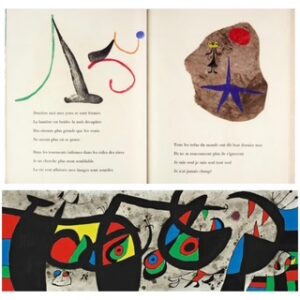
Most art lovers instantly recognise a Joan Miro image through the colourful child-like art with shapes and heavy black outline bordering these shapes. Blues, reds and blacks are using the first colours that you notice, colours that the Surrealists used quite boldly. Miro created his own cosmic world using lines and shapes to depict stars and planets and he used lines as ladders from the earth to the spiritual world and eyes for to show they were looking at the world from a spiritual point of view. Biomorphic shapes or blobs were the interconnection between animals, humans and plants. These symbols became unique to Miro and he used them over and over again in his artworks. After the rigidness of artworks from the Cubists, many found Miro’s fluidity a joy as his shaped danced, drifted and bounced into an open atmosphere which appeared to delight both art lovers and critics. We take a look at why Joan Miro livre d’artiste books are so highly sought after.
Parler Seul by Tristan Tzara Published by Maeght Editeur 1950
This book contains 72 original lithographs by Joan Miro; 49 in colour, the rest in black and white. These lithographs are wrapped around the 24 poems by Tristan Tzara poetry. Tzara was the co-founder of Dada a movement born from a deep-seated despair over the First World War, It aimed to champion nonsense and nihilism to systematically break down the high-society values and nationalism of its era. This book is considered a masterpiece of 20th-century printmaking as Miro integrated text and image in a fashion not seen before. Images were shaped around the text which and the text was not in in a straight orderly fashion as it was in most book. There were no blocks of text as the text ran vertically, horizontally and at different angles. Text and fonts were of different sizes on the same page making the text look just as artful as the images. Tzara wrote the poems without punctuation or capital letters in order that the words flow freely allowing the reader to pause reading at their own pace and find their own meanings to his poetry. He wrote the poems whilst at a psychiatric hospital as he was suffering from the effects of the War.
The first print run was 253 numbered copies with numbers 1-20 being the deluxe copies. These were printed on velin paper and are the most prized ones by serious collectors. Numbers 21-250 were printed on wove paper. There were also three hors commerce copies for the collaborators, Miro, Tzara and the publisher. All 253 copies are hand signed by Joan Miro and Tristan Tzara on the justification page. The lithographs were printed by Mourlot Freres and the text by Fequet et Baudier. They all have a matching lithographed chemise and slipcase. As these sheets were loosely folded to protect the lithographs so were left unbound as was the usual way with many livre d’artiste works, the wealthy buyers had them professionally bound by the likes of Georges Leroux, Paul Bonet, Paul-Louis Mercher and Monique Mathieu to preserve the artworks. Some have had individual plates professionally framed or sold them as loose sheets as breaking them up can often yield a bigger profit than if all were sold as one. Some later owners down the line have taken the plates out of the book and sold them on separately making a full book even more scarce. Some collectors hold onto them for many years so given these facts it is hardly surprising that they don’t often come for sale on the market. Christie’s, Paris estimated one of the deluxe copies numbered 1-20 with Georges Leroux binding at €30,000-€40,000 in May 2025. Copy number 178 with the original wraps and slipcase but lacking the original lithograph cover was estimated at £4,000-£6,000 in September 2026 at Sotheby’s, London.
A Toute Epreuve by Paul Eluard Published by Gerald Cramer 1958
With poems by Paul Eluard this Joan Miro Livres d’Artiste contains 80 original woodcuts and one for the cover, eleven of those with collage elements. This work is so sought after as it took a lot of planning and mapping out. Miro, Eluard and Cramer planned how this would be achieved and it took Miro 11 years to get the colour and design right. He carved 233 woodblocks himself and then impressed them around 42,000 times to ensure they were perfect in his eyes. Art historians consider it to be one of the most beautiful illustrated book achievements of the 20th Century. In seeking this perfection, he once again enabled the images to dance around the text so you were forced to look at the images and text as a whole, not separately. Using bits of objects like plastic, wood and wire inside the woodblock and keeping the wood grain visible he played around with his designs until he was happy with each result and then the same with the colours. Miro wrote to Cramer a year after starting work on the book in 1948 and in his own words stated “I am completely absorbed by the damn book… I hope to create something sensational”.
There were only 130 copies produced of the first print run, hence very rare. Numbers 1-20 are the deluxe copies on Chine paper. Of these 20 numbers 1-6 contain an original drawing by Miro and one of the original woodblocks with the ink on. They also contain 2 extra suites, one suite on Chine, the other on Japon showing some of the woodblock ink proofs and colour tests. He made notes on these and including his corrections by hand so these copies remain the ultimate collector copies. The are numbered in Roman numerals. Numbers 7-30 contain one extra suite of prints. Numbers 7-18 are numbered in Roman numerals and contained an additional suite of the 80 woodcuts. Numbers 19-130 contain the standard 80 woodcuts. All 130 copies were signed by Joan Miro on the justification page. Eluard died six years before Miro finished the woodcuts, hence his signature not on any copy of this title. There were also a handful of Hors Commerce copies (not for sale) which probably went to Miro, Eluard, Cramer and the Printers.
The chemise and slipcase were an extension of the artworks. The chemise which folder-like to house the loose sheets was made of boards with a real wood veneer to the back and front and a fine vellum or parchment spine depending on the standard or deluxe edition to protect the sheets. The slipcase also had a real wood veneer so you get a feel for the woodcut artwork that you would find. As many buyers threw away the slipcase to have the sheets professionally bound into a book, it is quite rare for one to come up for auction with the slipcase.
Copy number 1 previously belonging to the publisher Gerald Cramer where it later sold on to Genevieve and Jean-Paul Kahn sold for €385,855 in November 2019 via Pierre Berge & Associes at the Drouot auction house. This copy had the extra suites with the hand-written corrections on the proofs. It was professionally bound with the cover bound in and the chemise and slipcase present. The condition was very good as it had been well looked after being locked away for decades to preserve it. With the top end of the estimate being €200,000, it far exceeding it. The provenance of this particular copy was a factor besides for it being copy number 1 and in very good condition. The Kahn’s are one the finest art and bibliophile collectors in Europe having collected Dada, Surrealism and Avant Garde books having collected for over 50 years with their books being stored in a vault. Having the Kahn bookplate in the book proved to the collector not only was the provenance good but that that the book itself was well looked after and free from dust, smoke, sunlight and moisture.
Copy number 7 in Roman numerals with the extra suite of woodcuts and the original chemise and slipcase was estimated at Christie’s, Paris for €15,000-€20,000 and it sold for €56,700 in March 2024.
As many individual sheets were sold off separately there are many less than the 130 first print run copies of this title. One individual unframed plate from copies numbered 19-130 was estimated at £2,500-£3,000 at Forum Auctions in November 2026 and it sold for £2,600 on the day. If all woodcut plates were sold separately at that price the total would be £208,000. That plate was from one of the standard copies.
Le Lezard aux Plumes d’Or by Joan Miro, Published by Louis Broder 1971
Written and illustrated with 15 original colour lithographs by Joan Miro which were printed by the world renowned Mourlot printing company in Paris. The first print run was 195 numbered and signed copies. Numbers 1-20 were the deluxe copies printed on Rives paper with a Miro watermark. These 20 copies contain an extra additional suite of 13 original lithographs on Japon paper. All plates were signed and numbered in Roman numerals. Copies 21-170 are printed on Wove paper with the Miro watermark and no additional suites. There were also 10 hors commerce copies on Parchment paper. The plates are landscape format when the fold is opened out.
Although the cost of producing this livre d’artiste in part came from subscriptions, buyers were usually art galleries, art exhibitions and dealers of prints such as Gerald Cramer in Geneva or Pierre Matisse in New York. These were very expensive to produce in both time, labour and cost. The printers Atelier Mourlot were a prestige printing company whose prices to print the lithographs were part of the cost.
Le Lezard aux Plumes d’Or or, The Lizard with Golden Feathers, is so sought after as Miro created the poetic words over 26 pages, which he handwritten himself onto the lithographic stones as well as the colour illustrations. He danced the poetic text around the images to bring intertwine the two giving it movement and like a dance. The sad fact is that many copies get broken up and single plates sold off as the yield is often more than a complete set so they do not come up for sale too often. In December 2002 copy number 2 with the extra suite was estimated by Christie’s, London for £50,000-£70,000. It sold over the estimate at £94,650. One plate of the hors commerce edition sold for £2,540 including buyer’s premium at Chiswick Auctions in October 2026.
Les Penalites de l’Enfer ou les Nouvelles Hebrides by Robert Desnos Published by Maeght Editeur 1974
Written by the Surrealist poet Robert Desnos and illustrated with 25 unsigned and unnumbered lithographs by Joan Miro with 20 in colour and 5 in black and white which were printed by Adrien Maeght, Paris. The cover is one of those lithographs. The print run was 220 copies. Copies 1-15 are the first-tier copies and contain an additional 7 signed proof lithographs on vellum paper. Five of these proofs are numbered from 1-50 and 2 are reserved specifically for these deluxe copies. Only the colour proofs are signed. Numbered copies 16-50 are also deluxe sets but second-tier and contain 5 additional signed proofs, not 7 nor the additional 2 as in the first tier. Copies 51-200 contain just the 25 lithographs which are all unsigned. There were also 20 hors commerce copies numbered in Roman numerals and contain artists proofs which were reserved for collaborators such as Miro, the publisher, and the estate of Robert Desnos as these were published after his death. All 220 copies are signed by Miro on the justification page. These were printed in the landscape style in large format and were folded. They were all printed on Arches paper apart from the signed proofs. The cover is also an original lithograph. They are housed in a beige paper folder with the 50 deluxe copies, first and second tiers have the additional lithographs/proofs in another separate paper folder with the title Documents 129. All copies had the orange-coloured solander slipcase with Joan Miro and Robert Desnos names on the spine.
Miro and Desnos had planned a collaboration together in 1929 but the Spanish Civil War and World War II prevented that from happening. Desnos died of typhoid in a concentration camp shortly after the war ended in 1945. His widow requested to Miro that he should fulfil the collaboration in his honour. It makes sense that Miro would want to do his upmost best in creating the work with utter perfection. Miro concentrated on lithographs whilst Michel Otthoffer, a typesetter created the text from the metal press. He used different fonts of different sizes to flow from the Surrealist words that Desnos wrote in 1922 which translates to The Penalties of Hell, or, the New Hebrides.
Miro used bright colours of cobalt blue, emerald green, crimson red, yellow, and purple to create his stars, moons, eyes and biomorphic shapes. He likes to use heavy black brush strokes as a frame for his shapes as this made his brighter colours appear bolder, plus as his shapes are weightless being part of the cosmos, the black colour acted as a heavy weight to keep them in focus. His black inky heavy strokes gave movement like the calligraphy the Japanese used which was seen in Abstract Expressionism during the 1950s and 1960s.
A deluxe copy inscribed by Miro which contained 25 lithographs plus 7 proofs was estimated by Christie’s, Paris in November 2025 for €8,000-€12,000 and it sold for more than the top end of the estimate at €12,065. The paper folder and the slipcase were present. The inscription was to Daniel Lelong who was a prominent figure at Galerie Maeght. He was well-known art dealer himself and later jointly founded Galerie Lelong so no doubt the excellent provenance helped push up the price.
You may wonder why this title sells for much less than Le Lezard aux Plumes d’Or having more original lithographs. This is mainly due to three reasons:
- All the plates were signed in Le Lezard unlike in this title were only the proofs were signed.
- Miro produced both the text and illustrations whereas he produced only the original lithographs for this title. As the text was reproduced after the death of Desnos this has also reflected in the price as it appears more as a homage to Desnos.
- Homage works tend to sell for much less than the original work as in this case the Surrealist poetry.
Cantic del Sol Josep Carner, Published by Gustavo Gili 1975
Based on the classic spiritual writings by Saint Francis of Assisi Canticle of the Sun this book contains 33 unsigned etched aquatints on Guarro wove paper. The print run was 273, 250 were Arabic numbered copies and 25 hors commerce copies. All copies were signed on the justification page. Copies 1-2 are the publisher archive copies and contain two extra suites of the illustrations; one suite on Auvergne Richard de Bas paper the other on Japon. There is one suite of cancelled proofs on Arches paper and two rejected prints on Japon. The first-tier deluxe edition copies 3-12 contain one extra suite of the plates on Japon, one cancelled suite on Arches and two rejected plates on Japon. Copies Tier-2 of the deluxe copies numbered 13-30 contain one extra suite on Japon. Copies 31-250 contain no extras. The 25 hors commerce copies also contain no extra suites or plates. They are all housed in grey paper covers with deluxe tiers featuring a separate paper cover for the extra illustrations. The slipcase is yellow with Joan Miro’s name in red.
Miro was 82 when he created this work but had found inspiration from Josep Carner’s Catalan translation of Saint Francis’s hymn in the early 1960’s after reading the book. Miro chose to illustrate the hymn through visual rhythm through the use of cosmic signs and bold colours.
The graph below summarises the first print runs of each Joan Miro book title mentioned above.
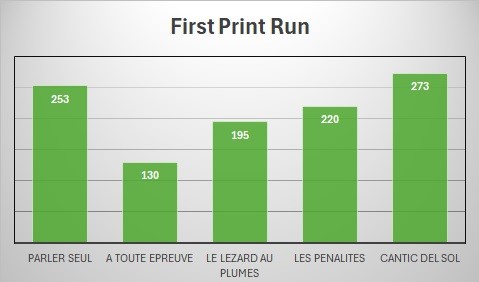
You can now understand why Miro’s livres d’artistes books are so sought after. They are quite rare due the very small limited edition print runs. Many of these have been dismantled and plates sold individually for more profit so there are even less copies available today. His fresh, bold and playful drawings are still appealing to this day and will no doubt remain so for a very long time. The time and effort that Miro has put in to create these spiritual cosmic masterpieces have been much appreciated by his collectors and followers and will continue to do so. As the books gets scarcer, prices will increase as the demand rises for those who can afford to buy them.