
Casino Royale Ian Fleming
Why Fleming's Original James Bond Would Hate His Own Movies
The Book
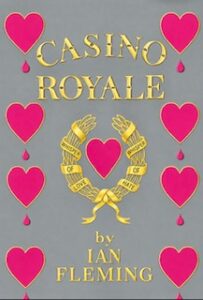
Casino Royale by Ian Fleming, published in 1953 by Jonathan Cape.
If Ian Fleming walked into a modern cinema to watch the movie ‘Casino Royale’ he would probably hate it. He penned the novel to be a gritty espionage thriller set in the Cold-War where the Secret Service aim to take down a Soviet agent named Le Chiffre by bankrupting him at a card table in a casino, to defuse a Communist union from destabilising western Europe from within. This was to be achieved through the 007 Agent James Bond who was a high-ranking Naval Commander who worked for the British government under MI6. He has a licence to kill under the State and is expected to do so in order to eliminate high-value targets in order to protect national security in Britain and the realm against any foreign threats in order that Britain can maintain their place on the global stage.
Why Ian Fleming Would Hate The Movie Version of Casino Royale
- Fleming would have had a shock when he saw Bond being played by the blonde-haired Daniel Craig, this was the first time a blonde-haired 007 agent was playing James Bond and this would have probably stunned the author as he had portrayed the 007 agent in the book as having dark hair with a prominent lock falling over his forehead and an old scar on his right cheek. I can imagine Ian Fleming say “No, No, No” when he saw the polished look and angular face of Daniel Craig playing James Bond. The initial backlash from fans was strong as people expected to see a dark-haired James Bond just like Fleming would have expected.
- James Bond in the novel wore tailored suits just like Bond in the movie but Ian Fleming would have hated the way the movie Bond’s suits were too rigid and refined. Bond needed to be able to move fast in his clothing so although the clothes were made with luxurious fabrics and custom-made they offered comfort and scope for movement which enabled Bond to look a little rugged.
- The 007 agent in the book also wore luxurious casual wear but the brand was unseen, but the movie 007 wore designer clothing showing the logos like the Armani leather jacket he wore at Miami airport and a Diesel leather jacket in Madagascar. Other branded labels were Ted Baker, Converse and Lonsdale plus others, making him look like a model for these designer brands. Although Fleming loved to show off Bond’s designer cars, cigarettes and alcohol he never shown branded clothing he would not have had Bond wanting to look like a paid fashion model.
- He would probably hate the way Bond has been transformed into some kind of superhero. The movie Bond is intelligent and confident and is portrayed as being indestructible unlike in the novel version where 007 was a cynical civil servant whose work was a governmental burden unlike in the movie where Bond saw his work as a glamorous adventure around the world.
- The Bond in the novel is more confident as he has much more experience and this shows in his calmness and effortless assurances that he gives. He does not need to prove himself unlike Bond in the movie where he feels he has to prove himself as a new recruit.
- In the movie version Bond has lots of flaws. He doubts himself often and shows his vulnerable side of which Fleming would not have approved. At the Baccarat table Bond completely loses it when he loses his initial stake to Le Chiffre, he grabs a steak knife after storming away from the table wanting to kill him. Unlike the book version where Bond has a moment of panic but keep his cool and stays focussed.
- Bond in the book questions the morality of his work, famously admitting to Vesper Lynd that he believes the lines between the Secret Service and the villains are dangerously blurred meaning he often wondered who was the good guy and who was the bad one. The 007 agent in the novel does not smile through his assignments; he actively hurts, suffers brutal physical torture that leaves him hospitalised for weeks. He contemplates resigning from MI6 out of sheer moral exhaustion. To the original Bond, the movie version’s ability to shrug off catastrophic violence that is unrealistic and over the top such as surviving bomb blasts and saying an amusing one-liner would feel like an insult to how espionage is fought in the book version.
- The literary Bond would hate how his private and public vices have been wrapped and marketed into a global lifestyle brand. In Fleming’s pages, Bond’s vices which include heavy smoking, fixated gambling and considerable drinking are coping devices of a damaged man who is trying to numb his mind.
- We read about Bond’s is internal agony in the book when he is being tortured and we read he struggles severely in trying to stay conscious by distancing himself from the agonising pain he is suffering from. The movie Bond handles it differently as he uses dark humour as a shield, famously mocking Le Chiffre mid-torture as if he is asking for more pain to be inflicted upon him and does not attempt to dissociate himself from it.
- In the book Bond has professional loyalty to ‘M’ and the Service regardless of any doubts he may have on the morale code of his assignments. He never goes rogue unlike the film version where Bond is portrayed as hasty and stubborn, and constantly sidesteps MI6 protocol, earning early distrust from ‘M’.
- Fleming would wince at the coarse Americanisation of the card room, viewing the pivot from aristocratic Baccarat to televised Texas Hold ’em as a vulgar betrayal of the elegance of casinos on the Continent to which he knew well from his training as an agent before the second world war. These casinos brought sophisticated people to them where they would play. It was a place for enjoyment and relaxation. These casinos were opulent, glamorous and graceful with low mood lighting setting the ambience. The movie version has bright, dazzling lights and the loud noise fills the room.
- The Bond in the movie is disobedient as he breaks into ‘M’s’ flat and steals secure MI6 tracking data to establish who had sent a text message to a bomb-maker in Madagascar the moment Bond had killed him as his access from gaining information was blocked due to him being blamed for a scandal at an international embassy. Ian Fleming would see this as treason not as heroic independent act as it is portrayed at the cinema. The bond in the book was a Naval Commander and would never go against the State’s orders nor would he disrespect ‘M’ by gaining access to her home without her approval due to his loyalty and respect for her.
- Ian Fleming wrote a suspenseful spy thriller that made the reader feel was realistic to some degree but the movie went way beyond that and the result was an unrealistic Hollywood-style blockbuster with over-the-top dramatics as when bond fell on several occasions at a height of about 115 feet onto the concrete ground at a construction site in Madagascar and got up unscathed. The human body could not have gone unscathed at those heights without broken bones at the least. Fleming would have found Bond’s indestructibleness laughable like most of us. The James Bond in the novel got hurt, bled and bandaged and his body and clothing reflected by looking bruised and unkempt unlike movie Bond who remained looking flawless despite falling through wooden beams and hitting concrete at some height.
- He would probably hate and dismiss the explosive, world-travelling set parts, such as the explosions on the airport runway in Miami and the chases in Africa, as it overpowers the intended quiet but tense atmosphere of the casino scene making it more like a Hollywood movie rather than British film. The dramatics in the film overtook the suspense that was contained in the novel.
- The version of Bond in the book was of a discreet 007 agent who kept a low profile unlike Bond in the movie whose aggressive presence make him stand out in a crowd. For example, when he tracked a lead staying in a luxury resort in the Bahamas, he deliberately crashed a car which drew attention from the crowd at to cause a distraction. The Bond in the written version would have stood in the shadows and observed discreetly, until he established his next move. He would never have drawn the attention of the police whilst on an MI5 mission as he would have deemed this as an act of recklessness.
- Ian Fleming wrote Bond as an emotionally detached character especially when it came to women unlike the movie version where Bond openly wept and wanted to give up his job over his girlfriend Vespa Lynd so he could live a normal life free from violence. The text version of Bond being detached emotionally was when he heard Vespa, who had betrayed him, had died, he made a call to the office and left a message to say “the bitch is dead” despite the fact that he had loved her.
I don’t think Ian Fleming would totally hate the cinematic version of his book Casino Royale as he would be quite pleased with himself that his novel had become so popular to new generations which he would have naturally got a buzz from despite James Bond looking and acting much differently than how he wanted him to be portrayed. He would have come to the conclusion that times have moved on since he wrote the book and expectations have changed along with that.
His book sales were around 4,000 in America when it was published there in 1954. The movie version went down a storm raking in $167.45 million. The movie was a sell-out globally and this would have delighted Fleming. He never would have dreamt when he was writing this title that it would have worldwide popularity more than 50 years after writing it. He would have felt an immense sense of pride in what he had achieved.
The Value of the Book Casino Royale 1953
A copy was estimated at Sotheby’s on the 22nd September 2026 for £18,000-£22,000 and sold for £22,860 on the day. The copy was unsigned and had the dust jacket. An inscribed copy to the author’s friend was estimated by Christie’s at £20,000-£30,000 and sold for £40,320 in December 2022. As there were only 4,728 hardback copies were printed in the first print run and more than half of these went to public libraries. As libraries tend to paste down dust jackets or they get stained and torn by those who take them out to read many dust jacket are removed so the book still looks good on the outside which encouraged reader to pick up and loan. Some readers who purchased the book automatically remove the dust jackets as they get in the way as some find it annoying when it slips slightly when opening the book. Many had a tradition of using it as a coaster to put a cup of tea on whilst they read the book. This shortage of the books cover means that scarcity enhances the price which is great if you have a copy to sell rather than wanting to purchase a copy. Signed or inscribed copies are rarer hence the higher price as there were no commercial book signings in Britain as a new author, these were more done in America in the big department stores during the 1950’s. He gave sighed copies of his books for his family, friends and colleagues such as his proof reader out of the initial first print run.