
Murder Puzzle Books
Can They Strengthen The Brain?
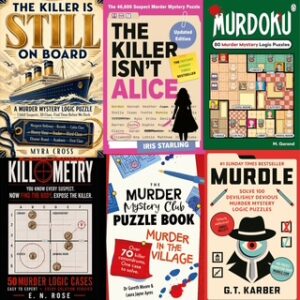
Can Murder Puzzle Books Strengthen The Brain?
Attempting to work out who is a killer or which weapon was used when you have many suspects and various murder weapons can be difficult to fathom out. By using various grids and puzzles certain people can be eliminated. This logical deduction forces the parietal and frontal lobes of our brain to activate our memory and complex thoughts.
When we are trying to solve the puzzle, the brain is releasing dopamine and norepinephrine which boosts our focus. When we force our mind to work something out, we are challenging it and making it work harder forcing it to create new pathways of brain cells. These new brain cells mean that if our brain does lose some cells at a later stage in life, the new ones we created through cognitive thinking means that these new cells can compensate for the lost ones. This is achieved in the horseshoe part of the brain known as the hippocampus which is located in the temporal lobe. This part of our brain deals with our spacial navigation and memory.
Murder puzzle books help our brain by helping us to remember patterns so we can work things out more quickly. Different parts of our brain are being used simultaneously whilst it gathers the information including the occipital cortex whilst we are visualising the puzzle, the hippocampus for the sequences and the temporal lobe for linking pieces of a puzzle together.
We can use all these parts in trying to work out who was the killer in the crime puzzle book The Killer is Still Onboard. You are given the ships manifest with 7,760 passenger names and 20 conditions that can only point to one of them. Your brain has to work through these 20 points by gathering and processing the information and ruling out all but one passenger every time you cross out a passenger name who could not have it. There are clues in plain sight and if you keep your brain active it will notice these clues faster. This book is ideal for those who love ships and ship-life as well as a good murder mystery.
In the book Murdle you can solve 100 devilishly devious murder mystery logic puzzles by examining clues, interviewing witnesses to help work out who is the killer, what was the murder and where the murder occurred. It is a fun way to solve the murder mystery which is good for the brain. There is no panic to the brain as it is all done in a humorous manner and is therefore enjoyable especially if you like being an armchair detective. By working through 100 puzzles, you can give your brain a really good workout by keeping it actively creating new cells and inroads to prevent it from dying off.
The book Murdoku gives you 80 murder puzzles with elements of Cluedo and Suduko where you have to place the person closest to the victim through a series of grid-based puzzles. Each one gets a bit more difficult as you work through the murder puzzle book forcing your brain to work that much harder which enables it to produce more brains cells.
If your brain does not get lots of information to navigate through certain parts can become dormant-like so when it has to think it may struggle a bit. Crime puzzles really help keep your brain performing to its optimum if it has to navigate and communicate with other parts of the brain. Crime involves three different complex thoughts; the killer, the weapon and the killer’s location to the victim. The brain is having to work out all this from the information that it sees through our eyes. When we feel that our brain needs a break, we stop looking at the puzzle and parts of the brain take a rest then it tells us that it is ready to absorb information again. If we leave it for a long time without making it communicate with other parts it can struggle to get started again. Think of your brain like a car that has not been used for a while. When you try to start it, you may have to turn the ignition key several times before it fires up. Our brains struggle that way too. So, the more we use it to problem solve, the less problematic it will be in the future as we age.
In the book The Killer Isn’t Alice there are 46,600 suspects and one murderer. To work your way through the suspects you are 18 clues. You have to use the art of deduction to rule out 46,599 suspects. Your brain helps you do this by decoding the information it sees against any known facts. A network of structures within the brain and applies logic to deduct the suspects and form a logical conclusion through the inferior frontal gyrus and insula after the prefrontal cortex and the parietal cortex has extracted the patterns of the planning, logic and spatial reasoning of the information it has captured and processed.
In the book Killometry you have to find the victim and the location to expose the killer so your spatial reasoning is challenged even further. Your brain is still working through the network of structures as in finding the killer rather than the victim but in a different way as your brain is looking at solving the series of puzzles to ascertain which room the victim could be and which weapon was used by the killer.
The answer to the question then is a definite yes. Crime puzzles do help strengthen our brain by linking and mapping various parts and creating new cells. It is important to remember to choose a level that gives your brain a good workout without it being too complicated for you as this can cause frustration and stress. When you are beginning to struggle with a crime puzzle put it down and rest your brain for a while it takes time out. An overworked brain gets cognitive fatigue and will struggle when its overloaded and may cause you moments of brain fog. Crime puzzles are best suited to those who enjoy reading crime and will bring more pleasure than an ordinary puzzle book. We all like to feel we know ‘whodunit’ and when we are correct our endorphins are released and we feel extra pleasure.
Here are six crime puzzle books we have mentioned or shown in the image above to give your brain a bit of exercise;
- The Killer is Still Onboard by Myra Cross
- The Killer Isn’t Alice by Iris Starling
- Murdoku by Manuel Garand
- Killometry by E. N. Rose
- The Murder Mystery Club Puzzle Book Murder in the Village by Gareth Moore & Laura Jayne Ayres
- Murdle by G. T Karber