
Paul Bonet Fine Binding
Are They Worth Collecting?
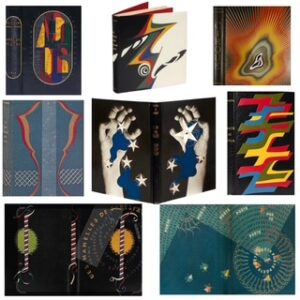
Paul Bonet (1889-1971) created some very artistic book bindings during his 40-year career. He incorporated the designs that were associated with the Art Deco Movement, The Surrealists and Fauvist movements. There are Paul Bonet fine binding books which are either unique one-offs or the design has been used in a very limited number of bindings and the more mass-produced bound books made of cloth with his designs.
Paul Bonet Fine Binding Designs
- He replaced traditional illustrations with rigid structures, using intersecting grids, sharp perspective lines, and repeating semicircular patterns to give covers a modern, streamlined look. His artistic vision was revolutionary.
- Instead of standard labelling, he transformed the book’s title into a major structural element, integrating typographic design with floating curves, weaving the letterforms directly into the cover’s overall geometric pattern.
- He juxtaposed high quality goatskin leather with striking exotic textures like sharkskin, snakeskin, smooth parchment, palladium, eggshell, lacquer, wood and polished wood and was innovative in his technique and materials he used for his book binding.
- He designed and bound first edition and deluxe edition books for famous painters and poets of the day including Pablo Picasso, Rene Char, Andre Breton, Tristan Tzara, Andre Gide, Max Jacob, Paul Eluard, Joan Miro, Salvador Dali and Man Ray. The Surrealist painters wanted their books bound to match the Avant Garde written and artistic words and Paul Bonet was the first choice as they trusted his designs and knew that they would get the design right and which would please them. Surrealism which incorporated non-rigid geometrical shapes, floaty dream-like figures that often looked distorted. He designed and bound books in the Fauvist design using bold colours and non-symmetrical shapes. He bound a copy of Nadja, an autobiographical novel, by Andre Breton, the founder of the Surrealist movement, for Rene Char. Breton is fascinated by Nadja due to her vivid imagination and untied grip on of the real world. Her behaviour was quite erratic and Breton believed that this embodied the ideals of Surrealism.
- Many of these are bespoke bindings and therefore one-of-a-kind which makes them very highly sought after when they come on the market.
- He embedded industrial, polished metals like nickel and aluminium alongside recessed glass-enamel blocks into dark leathers to capture the reflective, high-contrast look of the Machine Age. Bonet reinvented bookbinding practices as the usual bookbinding practices going back hundreds of years involved mainly organic materials that were flat and smooth like goatskin, silk and gold leaf. Bonet’s machine age metals, embossing and the use of everyday products being broken up and used including clothing creating a three-dimensional look and feel which made him quite unique in his manner of binding books.
- Bonet had rejected the way other book binders’ hand tooled and used metal presses for the designs of the binding. Bonet collaborated with toolmakers to cut the materials and place other materials like polished metal and coloured glass between the cuts thus being innovative in the architecture of the books structural binding.
Paul Bonet Cloth Bound Books
From 1941 Bonet worked with the publisher Gallimard (NRF) to create designs for the covers on their hardback books that were to be machine pressed onto the cloth. Bonet did 550 designs in total between the years 1941-1967 of major French literary fiction, theatre and poetry, science, philosophy and essays and translated modern classics from other countries. Many of these mirrored his deluxe fine leather binding designs. These were published in print runs of between 500-2000 copies for the earlier ones and the more later popular books had a print run of between 1,000-10.000 limited edition numbered copies. Some were multi-volumes of collected works.
Value of Paul Bonet Bound Books
The value of Paul Bonet bound books depends on whether it is a fine, leather bound or a cloth bound. As the fine binding ones are deemed museum pieces due to the uniqueness mainly one-of-a-kind, they can sell for tens of thousands to hundreds of thousands of pounds depending on provenance, signed, condition and such.
He bound a copy of Nadja, an autobiographical novel, by Andre Breton, the founder of the Surrealist movement, for Rene Char. Breton is fascinated by Nadja due to her vivid imagination and untied grip on of the real world. Her behaviour was quite erratic and Breton believed that this embodied the ideals of Surrealism.
The book ‘Nadja‘ by Andre Breton as discussed above was unique and sold for €352,800 at Christie’s in May 2025. This was Rene Char’s copy gifted to him by Breton and signed by Char and Breton with lots of personal annotations hence the staggering hammer price. In 1999 this exact copy was estimated at £60,000-£80,000 and sold over the estimate at £91,600 with buyers premium. That is a staggering profit within 26 years. £131,582 at the average Bank of England base rate of 3.5%.
Bonet’s Surrealist designs are highly favoured by collectors out of all the designs.
Unless you are lucky enough to find one of these finely bound books by Paul Bonet you will pay several thousand at least for a copy that has no known provenance. Most of the artist bespoke books are in museums, other institutions and the hands of very wealthy collectors.
His designs on the Gallimard cloth and card cover type paperbacks are worth collecting only if you collect the ones in small print runs that are numbered as the others are unlikely to yield a good investment for the future. These are much easier to obtain and the price is much cheaper and can purchased from £300 upwards to £3,000 for volume sets.
These books have been mass produced over and over again so anything dated after his death in 1971 unless it is a posthumous deluxe catalogue of his work which sell for around £2,000-£3,000.
Sadly, Paul Bonet’s finely bound books are only worth collecting if you have the money to do so due to their exceedingly high price whether you buy at auction or a retailer as these are seen as works of art. If you can afford it, they are a good investment. Condition is important so buy the ones in the fine condition or nearest to it. Fine binding becomes less fine if the leather is greatly rubbed and soiled with damp stains and such. Go for ones that have provenance, where its history can be tracked. Collecting cloth bound Paul Bonet designs in low print runs are likely only to be a good investment if you intend to hang on to them for many years.
Disclaimer
All reviews and opinions on this blog are purely my own and are provided strictly for informational and entertainment purposes and not financial advice.