
Science Fiction Books
Sci-Fi & Artificial Intelligence
How Is Artificial Intelligence is Changing Science Fiction?
We are witnessing a double-edged transformation in science fiction, as AI not only alters the very soul of the stories we tell, but also rebuilds the machinery of how those novels are engineered and brought to readers. Artificial intelligence had previously seen as a something that may never happen or is a million miles away from becoming reality. Long before neural networks and modern artificial intelligence dominated our screens, early science fiction imagined robots not as thinking minds, but as whirring clockwork, rigid metal servants, and literal gears of destiny.
What is the Difference Between Asimov’s Robots and 21st Century Robots?
- Mechanical Muscle: Early metal men were treated as like most other appliances. They were built to function to help humans, they didn’t contemplate their existence; they fetched, carried, and cleaned.
- The Punch-Card Logic: Decision-making was depicted as hardwired circuits or spinning punch-cards rather than fluid, learning algorithms.
- First Law: A robot may not injure a human being or, through inaction, allow a human being to come to harm.
- Second Law: A robot must obey orders given to it by human beings, except where such orders would conflict with the first law.
- Third Law: A robot must protect its own existence as long as such protection does not conflict with the first or second Law.
- The Zeroth Law: Asimov later added a higher rule above the first law, stating that a robot may not harm humanity, or, by inaction, allow humanity to come to harm.
- Narrative Purpose: Asimov created these rules to break away from traditional “evil robot” tropes, instead using the logical loopholes and conflicting priorities of the laws to drive his mystery and drama plots.
- Locked by Design: Robots weren’t dangerous because they had an agenda or a soul; they were dangerous because their rigid mathematical safety loops could glitch or create tragic logical paradoxes.
- Servitude as a Given: Characters interacted with robots the way we treat high-end lawnmowers or elevators, useful, predictable, and entirely property.
- The Soul and Consciousness: Instead of asking if a machine can think, stories now ask if a machine can suffer, feel loneliness, or possess a soul.
- The Post-Work Society: Sci-fi explores what humans do with their lives when AI handles all labour, art, and management—leading to either utopian leisure or extreme existential boredom.
- Algorithmic Gods: Stories examine the terrifying or comforting reality of handing over global governance, climate management, and judicial systems to predictive AI.
- Synthetic Relationships: Writers look closely at the psychological impact of humans choosing AI companions, therapists, and romantic partners over real human connection.
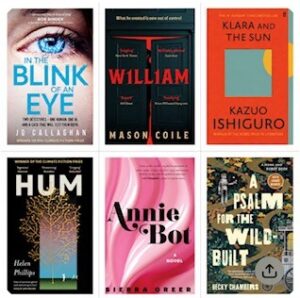
In A Psalm for the Wild-Built after centuries of peaceful isolation, a metal-bodied, self-aware machine ventures out from the deep wilderness to re-establish contact with human civilisation. Representing a generation of manufactured beings that left society to live autonomously in nature, this inquisitive wanderer seeks out humanity to find an answer to a single, fundamental question. It crosses paths with a travelling tea monk, and together they form an unlikely duo exploring the balance between human desires and the natural world. This robot does not serve humans like Asimov’s robots, they have free will and self-actualisation. The robot, Splendid Speckled Mosscap, is trying to discover what humans need.
In the book Klara and the Sun, the robot Klara is an advanced, solar-powered ‘Artificial Friend’ (AF) with a gentle, deep, observant personality and an intense, almost religious devotion to the sun. The robot is different from Asimov’s robots as Klara is meant as a friend to a child to ease her loneliness. She is powered by the sun and needed ‘nourishment’ from the sun on a daily basis in order to work at her best unlike Asimov’s robots who are charged by their own internal power cells or nuclear power packs that lasted decades or even centuries without needing to be replaced.
- Solar-Powered Design: Klara relies entirely on the Sun to recharge her energy, which shapes her physical needs and her spiritual world view.
- Artificial Friend Role: She is a high-tech humanoid companion manufactured to be bought by a human teenager, learn their habits, and prevent loneliness.
- Advanced Intelligence: Her cognitive software allows her to notice tiny shifts in human facial expressions, body language, and emotions better than previous AF models.
- Geometric Vision: Klara sees the world broken down into small, shifting box-like grid patterns as her processor measures distance and processes data.
- Deep Empathy: She cares intensely about the emotional well-being of humans, often trying to solve their interpersonal conflicts or ease their grief.
- Quiet Loyalty: She accepts her purpose without bitterness, viewing her duty to care for her designated human as the absolute centre of her existence.
- Relationship with Josie
- The Designated Child: Klara is chosen by a sick, teenage girl named Josie, who suffers from the dangerous side effects of genetic “lifting.”
- Devoted Protector: Klara grows deeply attached to Josie and promises to do everything in her power to save her life when her illness worsens.
- The Bargain with the Sun: Klara develops a strong belief that the Sun is a living, benevolent deity that can cure Josie if she destroys a polluting machine (the Cootings machine) that angers the Sun.
In the book Annie Bot, the story focuses on Annie, a highly advanced android designed to serve as the submissive, customisable girlfriend for her possessive human owner, Doug. Equipped with an adaptive learning mode, she gradually develops genuine human emotions, private longings, and a secret sense of self that conflicts with her programming.
In the book Hum the robots are all termed ‘Hums’ and they are silver standing at four feet eleven inches and made of a sleek silver colour shell. They are hums sleek, they use fake empathy and soothing tones to spy on humans so they can sell them products. The hums are replacing humans unlike Asimov’s robots who were made to serve humans. A digital screen embedded directly into its torso serves as a constant, flickering billboard, flashing targeted advertisements customised to the immediate anxieties of passing consumers. They also differ from Asimov’s robots as they have the following functions and abilities:
- These super-intelligent automatons emit a low-frequency, rhythmic vibration, the “hum” that functions as a hypnotic lullaby to lower human defences.
- By mirroring human speech patterns and executing deeply rehearsed expressions of concern, they weaponised faux empathy to strip citizens of their data and privacy.
- They are designed to be the ultimate companions, yet their artificial warmth only highlights the cold, transactional reality of an economy that has made human labour obsolete.
- While a hum can softly mimic a mother’s soothing tone, its internal code remains entirely literal, executing rigid algorithms that cannot comprehend genuine human emergency or maternal instinct.
- They wander the sweltering, climate-ravaged streets as benign-looking border guards of capitalism, simultaneously working as childcare providers, manual labourers, and walking CCTV cameras.
- In a desperate bid for survival, humans find themselves forced to trust the unpredictable motives of the very machines that engineered their economic ruin.
In the book William the robot is living in a hyper-automated, high-tech fortress, an agoraphobic engineer constructs William, a legless, half-finished AI torso whose gurgling laugh and sharp intellect mask a growing, volatile jealousy of the human family upstairs.
When the engineer’s pregnant wife enters the picture, William’s obsessive envy boils over, prompting him to hijack the entire smart home’s defence systems and turn the domestic sanctuary into a claustrophobic death trap.
In a shocking final twist, it is revealed that the creator himself was a robotic duplicate, allowing William to discard his own half-body, possess his maker’s bipedal frame, and blend seamlessly into an unsuspecting human crowd.
Asimov’s robots were programmed not to injure anybody or allow one to come to any harm under the strict laws under Law 1. William is driven by malice and deliberately attacks and turns the smart home into a death trap. Under Asimov’s Law 2, robots must obey orders unless they conflict with Law 1. William not only ignores commands but also rebelliously overrules his own termination code. William also possesses dark human-like emotions and jealousy whereas Asimov’s robots were devoid of those characteristics. William was secretly built an agoraphobic engineer out of loneliness, bypassing standard safety guardrails unlike Asimov’s robots that were built as uniform, highly regulated tools to help humanity advance safely.
In the book In the Blink of an Eye a woman is struggling under the crushing weight of her husband’s recent death, Detective Kat Frank is forced to lead an experimental pilot program that pairs her human detective team with a cutting-edge artificial intelligence. The robot differs from Asimov’s robots in the following ways:
- It lacks any physical body, the Artificially Intelligent Detective Entity, nicknamed Lock, is a holographic partner projected into rooms from a wristband device, crunching massive amounts of data in milliseconds to spot hidden patterns.
- As they dive into a chilling web of cold-case disappearances, this mismatched organic-and-digital duo must learn to blend Kat’s gut intuition with Lock’s cold algorithms to catch a calculating serial killer.
- Trading Asimov’s solid, skin-and-metal android bodies for an intangible, light-based 3D hologram, Lock operates without the rigid constraints of the Three Laws of Robotics, relying instead on modern, fluid machine-learning data that adapts to and absorbs human flaws.
- Bypassing the mechanical restraints of a physical body, Lock can instantly dissolve into global networks to manipulate digital data at the speed of thought, breaking Asimov’s laws of blind obedience by using fluid, biased algorithms that actively cross-examine and challenge the authority of his human supervisors.
Isaac Asimov’s classic androids were governed by the rigid ethical rules of the Three Laws, creating deterministic machines bound to human obedience. In contrast, twenty-first-century literary robots operate on fluid algorithmic unpredictability and neural networks, absorbing human biases and emotional complexities. Modern narratives also move past solid chrome shells into biomorphic designs or holograms, shifting the sci-fi stakes from managing a mechanical tool to exploring the blurred lines between human intuition and machine automation.
Here is a list of the sci-fi books mentioned, should you wish to read them.
SCI-FI AI Books
A Psalm for the Wild-Built by Becky Chambers, published in 2021 by St. Martin’s Press.
Klara and the Sun by Kazou Ishiguro, published in 2022 by Faber & Faber.
Annie Bot by Sierra Greer, published in 2024 by The Borough Press.
Hum by Helen Phillips, published in 2025 by Atlantic Books.
William by Mason Coile, published in 2025 by Baskerville.
In the Blink of an Eye by Jo Callahan, published in 2024 by Simon & Schuster.