
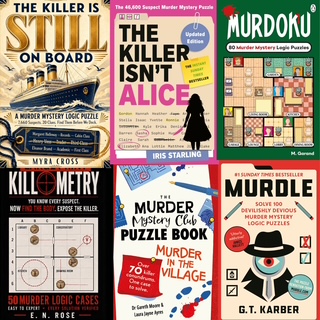
Murder Puzzle Books
Attempting to work out who is a killer or which weapon was used when you have many suspects and various murder weapons can be difficult to fathom out. By using various grids and puzzles certain people can be eliminated. This logical deduction forces the parietal and frontal lobes of our brain to activate our memory and complex thoughts.
When we are trying to solve the puzzle, the brain is releasing dopamine and norepinephrine which boosts our focus. When we force our mind to work something out, we are challenging it and making it work harder forcing it to create new pathways of brain cells. These new brain cells mean that if our brain does lose some cells at a later stage in life, the new ones we created through cognitive thinking means that these new cells can compensate for the lost ones. This is achieved in the horseshoe part of the brain known as the hippocampus which is located in the temporal lobe. This part of our brain deals with our spacial navigation and memory.
Murder puzzle books help our brain by helping us to remember patterns so we can work things out more quickly. Different parts of our brain are being used simultaneously whilst it gathers the information including the occipital cortex whilst we are visualising the puzzle, the hippocampus for the sequences and the temporal lobe for linking pieces of a puzzle together.
We can use all these parts in trying to work out who was the killer in the crime puzzle book The Killer is Still Onboard. You are given the ships manifest with 7,760 passenger names and 20 conditions that can only point to one of them. Your brain has to work through these 20 points b gathering and processing the information and ruling out all but one passenger every time you cross out a passenger name who could not have it. There are clues in plain sight and if you keep your brain active it will notice these clues faster. This book is ideal for those who love ships and ship-life as well as a good murder mystery.
Murder Puzzle Books Read More »