
The Big Sleep Raymond Chandler
Unpacking Chandler’s Tangled Masterpiece
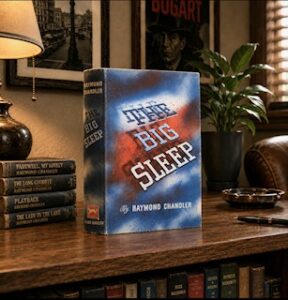
The Book
The Big Sleep by Raymond Chandler, published in 1939 by Alfred A. Knopf
Six Murders and an Unsolved Plot: Unpacking Chandler’s Tangled Masterpiece
Raymond Chandler investigates six murders in his 1939 book which has since become a masterpiece of fiction. He doesn’t solve crimes like other modern detectives do by fitting the pieces together like a jigsaw puzzle. Instead, his methods resemble an uncontrollable apartment fire, one panic-driven explosion accidentally triggering the next, leaving private eye Philip Marlowe to navigate the smoke. Rather than a grand, calculated criminal conspiracy, the body count in The Big Sleep is a frantic cascade of human error, desperation, and tragic misunderstandings. Here is how the dominoes actually fall.
Murder No.1
Rusty was a charismatic, ex-smuggler who became General Sternwood’s favourite companion. This drew the obsessive attention of the General’s unstable, psychopathic daughter, Carmen. When Carmen cornered Rusty and demanded he sleep with her, he laughed and pushed her away. Unable to handle the rejection, Carmen threw a violent, childlike tantrum, drew a gun, and shot him dead. Vivian Sternwood discovered the bloody scene and went into a blind panic. Terrified that the shock of the murder would literally kill their frail, dying father, Vivian paid gangster Eddie Mars’s hitman $15,000 to dispose of the body. They drove Rusty’s body out to an abandoned, sludge-filled oil pit on the Sternwood property and sank it. To explain the sudden disappearance, Eddie Mars made up a lie and said that Rusty had ran off with Mars’s own wife, Mona and he spread this lie to others so word would get around so it sounded more believable. Mars then hid his wife away to corroborate the story. He thought that this lie would keep the police from further investigating her disappearance and gave Eddie Mars leverage to blackmail Vivian into giving him anything he wanted for rest of her life.
Philip Marlowe in his search for Rusty Regan’s body looked for flaws in the killer’s cover story and sets a lethal trap rather than looking for clues or the forensic evidence.
Instead, he follows his nose until he found Mona Mars where he finds her living in forced, quiet isolation under the watchful eye of a mob hitman. The moment Marlowe confirms Mona is not with Rusty, the alibi is blown and he suspected that Rusty was already dead, and Mars was being paid to hide the killer.
To find out who pulled the trigger, Marlowe focuses on the erratic behaviour of General Sternwood’s youngest daughter, Carmen. During the investigation, Marlowe returns a pistol to Carmen after taking out the bullets and replacing them with blanks. He asks her to take him to the area around the oil pit for a shooting lesson. He starts to taunt her to test her emotions and rejects her advances. Just as he anticipated, she pulls out the gun and points it at his chest before pulling the trigger. He then confronts her sister Vivian who cracks under the pressure and reveals all. He had solved the crime before the body was uncovered.
Murder No.2
Arthur Gwynn Geiger was victim number two. He was being tailed by Marlowe as he had suspected him of mastering a pornography ring catering to LA’s wealthy elite. He sees Geiger taking Carmen home with him who looked like she was drunk. He saw them go inside and waited in his car whilst staking him out. He saw the flashlight of the camera and heard three gunshots and a scream. The Sternwood’s chauffeur Owen Taylor had killed him after he saw Carmen sitting naked in a large ornate chair and looking out of it whilst Geiger was filming her as part of his pornographic dealings and with a view of blackmailing the wealthy Sternwood family. He took the film from the camera before fleeing the scene.
When detective Philip Marlowe went in moments later, Carmen was giggling mindlessly and Geiger’s body was on the floor. He took the house keys and the ledger with the names of Geiger’s customers who were wealthy prominent people in LA, to protect General Sternwood who had hired him and to whom he therefore owed a duty to him morally as a client and to gain time to solve the murder.
He dressed Carmen and her in his car to take her back home to the Sternwood’s mansion. He returns to Geiger’s house and realises the body has gone from the room and the place has been cleaned up. He evaluates the room taking notice of a totem pole with a hidden camera which Geiger must have used to film his victims. Initially Marlowe thought the killer was Joe Brody and a bookstore worker named Agnes who were the killers as something in the journal pointed towards this. They wanted to take over Geiger’s business to extort money from his clients. Instead of following the evidence to lead to the killer, Marlowe had used psychological tactics, when a car was pulled out the water with a body in the driver’s seat was that of the Sternwoods chauffer, he dug into his background which led him to the knowledge that Owen Taylor had been madly in love with Carmen and the family had him thrown in jail when they discovered that their trusted chauffeur had tried to elope with her. He confronted Vivian, Carmen’s sister who panicked and told him all she knew. By investigating independently from the police and following his own leads and not theirs he was able to determine what happened at Geiger’s house on the night.
Murder No.3
The third victim was Owen Taylor, the lovesick chauffeur. His body was found at the wheel of a limousine when it was pulled out the water whilst Marlowe watched the scene unfold. The medical examiner revealed that Taylor died of had died drowning and a broken neck. There was also a bruise on the back of his head which happened before he died.
Marlowe then tracked the missing photographic plates of Carmen to the apartment of Joe Brody, a small-time crook. Marlowe forced his confession when Brody felt threatened by his demeanour, his arrogance and his gun. Marlowe tells him he saw him there at Geiger’s property on the night of the murder and that he saw Taylor flee with the film, pursuing him and hitting him on the back of the head to steal the film to be used as blackmail but denied killing Taylor as he drove off after he whacked him on the back of the head. Marlowe believed him as he saw how panicky he looked. Brody opened the door of the apartment when he heard the doorbell ring only to be shot dead which left Marlowe’s investigation on the death of Owen Taylor at a dead end. Because Chandler famously forgot to write a resolution for this death, later telling a movie director he had “no idea” who killed him, it remains one of his accidental mysteries. Whether Taylor had killed himself by driving into the water or a rival con artist had killed him remains a mystery within literary circles.
Victim No.4
Joe Brody became the fourth victim that Marlowe investigated the death of. He had quickly turned the lights off to become invisible and then chased the killer down the stairwell with such speed before confronting the killer with gun in hand who was about to get away in a car. He then saw Carol Lundgren behind the wheel, Geiger’s young chauffeur who was also his secret lover and drives him back to Geiger’s house. He discovers that Lundgren had assumed that Brody masterminded the murder of Geiger to steal his blackmailing business. With the shooter caught red-handed and the blackmail photos safely in his pocket, Marlowe finally calls the police to clean up the aftermath. By using his own ruthless tactics Marlowe had learned that Brody was not a killer and that Lundgren was mistaken as to who the killer of Geiger was. Marlowe did not call the police the moment the shots were fire he acted aggressively and alone in chasing the killer to force him to stop the car before it sped off. Only once he had control of the narrative did he then call the police.
Victim No.5
Harry Jones, the fifth victim, was a small-time criminal who went to Marlowe in his office to sell information regarding the whereabouts of Eddie Mars’s wife when she was in hiding. Marlowe briefly left the office to get the $200. On his return he heard Jones was being interrogated so he crept into an adjacent room and listened and saw what was going on through the partition wall. He wanted to know the address of where Agnes Lozelle was, Harry gave him a false address to protect his girlfriend before Lash Canino, a henchman of Eddie Mars, killed him with cyanide. Marlowe had to watch Jones die in agony as he couldn’t intervene as Canino was a professional hitman with his gun out, and Marlowe was behind a wall and would have been killed if he tried to barge in as Canino had the advantage due to his position. When the hitman leaves Marlowe comes out and the phone rings it is Agnes who is unaware of what has just happened. Marlowe decides to deal with the killer himself rather than leave it to the law.
Victim No.6
Lash Canino, was the sixth person to be murdered after Marlowe had tracked him down. Marlowe had instructed Agnes to stay put and orchestrates a midnight meeting in a dark, rain-swept alleyway. Climbing into the back of her car, Marlowe pays Agnes the money he originally promised to Jones. In exchange, a grieving and terrified Agnes gives him the location of Mona Mars’s hideout, which was an isolated, remote auto-repair garage forty miles east of Los Angeles. Marlowe acted like a vigilante in hunting the killer, luring him with the noise of out and then shot him forming his own rough justice. He cleans up the mess before reporting the shooting as self-defence.